
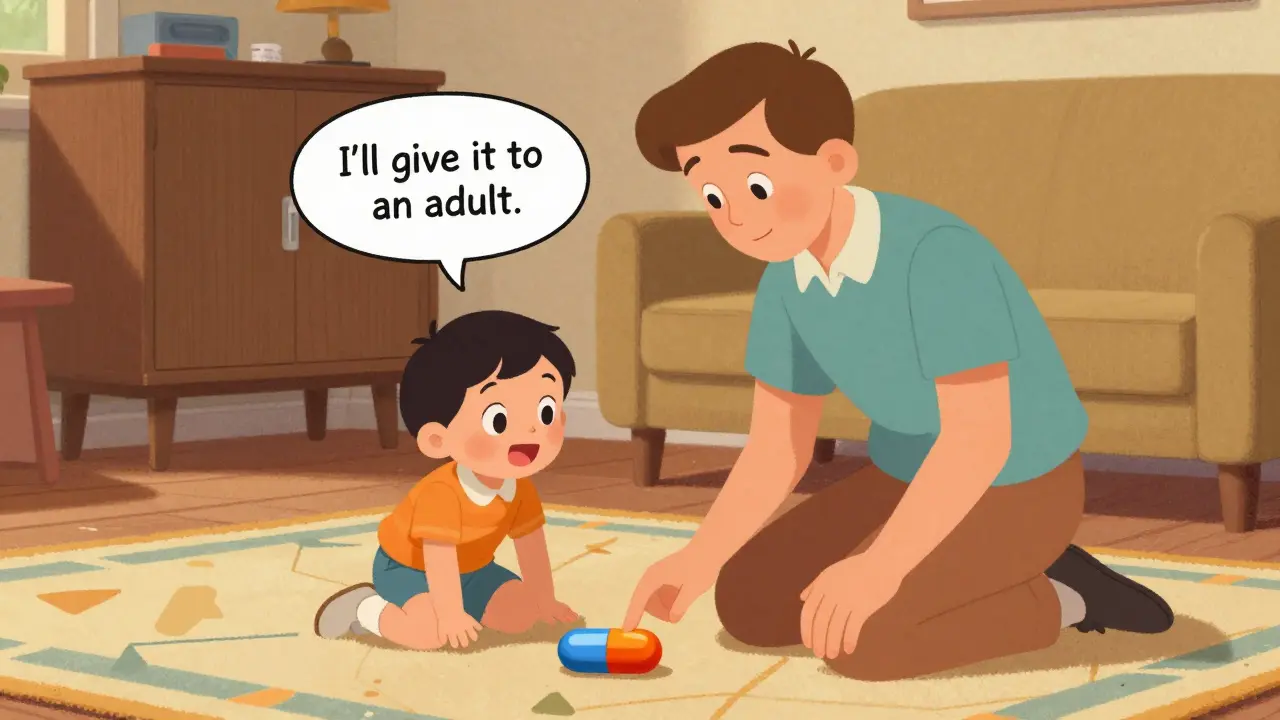
Every year, 50,000 children under five end up in emergency rooms because they accidentally swallowed medicine they found at home. Some of these pills - like opioids, heart meds, or even prenatal vitamins - can kill a child with just one or two doses. And it’s not just at home. Schools, grandparents’ houses, and daycare centers are also risky places if kids don’t know what to do when they see a pill or liquid bottle.
Here’s the hard truth: kids don’t know the difference between candy and medicine unless we teach them. And if you’ve ever left a pill on your nightstand, stored medicine in your purse, or taken a pill in front of your toddler, you’ve unknowingly put them at risk. The good news? Children as young as three can learn how to stay safe - if we teach them the right way.
Why Kids Mistake Medicine for Candy
Medicines aren’t just dangerous - they’re designed to taste good. Liquid antibiotics come in bubblegum and grape flavors. Chewable vitamins look like gummies. Even some prescription pills are brightly colored and shaped like animals or stars. To a young child, they’re just another treat.
A 2019 study by the Rocky Mountain Poison and Drug Center found that calling medicine “candy” - even as a joke - increases the chance a child will swallow it by 220%. That’s not just careless. It’s dangerous. The FDA warns that children under four will copy what adults do. If you pop a pill in front of them, they’ll try to do the same. One 2021 study showed that 78% of toddlers under three imitated adult medication use within a minute.
So the first rule? Never take medicine in front of kids. Ever. Not even a single aspirin. Don’t say “I’m taking my candy.” Don’t leave pills on the counter. Don’t let them see you open a bottle. Kids learn by watching. If they think medicine is normal to eat, they’ll eat it.
What Kids Should Learn at Each Age
Teaching medication safety isn’t a one-time talk. It’s a step-by-step process that changes as kids grow. The FDA and pediatric experts have clear guidelines for what kids can understand at each stage.
- Ages 3-4: Teach them to say, “I found a pill - I’ll give it to an adult.” They don’t need to know what it does. Just that they shouldn’t touch it or taste it. Practice with toy pills or empty bottles. Role-play: “What if you see a red pill on the floor?”
- Age 5: Kids can start to recognize that medicine has a name. Let them help put a sticker with their name on their medicine bottle. Teach them: “Only take medicine when Mom or Dad says so.” They should also know to tell an adult if another child is playing with medicine.
- Age 6: They can start reading labels with you. Point out the child’s name, the dose, and the time. Ask: “What does this say we should do?” Practice using a medicine syringe - not a spoon - to measure liquid. Household spoons can be off by 40% to 98% in dose size.
- Age 7: They can learn school rules: “Never take medicine from anyone except the nurse.” They should know how to check the label against what the doctor or parent said. And they should understand that taking medicine in front of younger kids is dangerous - because little ones copy them.
- Age 8: Kids should know their own weight. Dosing is based on weight, not age. If they’re 50 pounds, they need a different dose than a 70-pound child. This helps them understand why their brother gets a different pill.
These aren’t just nice ideas. They’re life-saving skills. A 2021 study from Nationwide Children’s Hospital found that kids who got this kind of training were 47% better at telling medicine apart from candy than kids who didn’t.
How Schools Are Helping - And Where They’re Falling Short
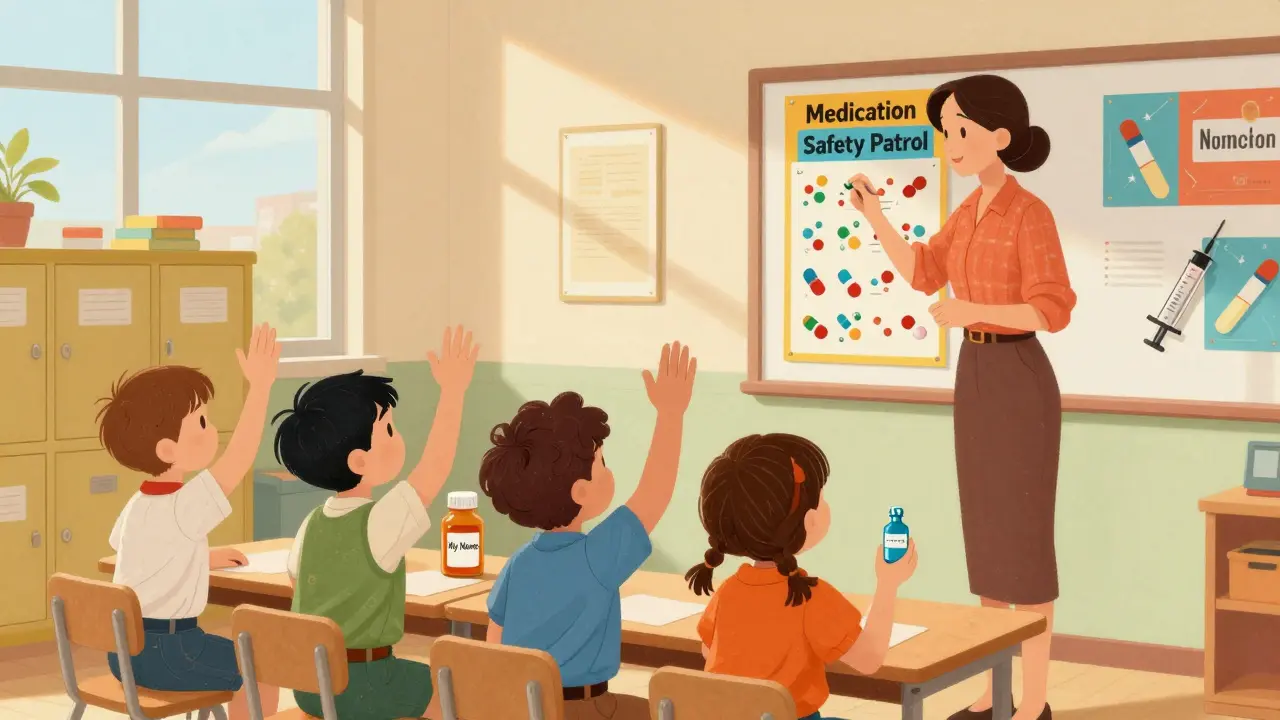
Programs like Generation Rx’s “Medication Safety Patrol” are being used in over 1,200 U.S. schools. Kids role-play finding pills, reporting them to the nurse, and learning why they shouldn’t share medicine. The program includes videos, coloring sheets, and games - all designed for kindergarten through fifth grade.
But here’s the problem: only 39% of U.S. schools have a full-time nurse. In rural areas, that number drops to 32%. That means in many classrooms, there’s no one trained to teach this. Teachers are expected to handle medication administration without training. One teacher on TeacherForum.org wrote: “I was given a bottle of ADHD meds and told to give it at 11 a.m. I didn’t know how to check the label or what side effects to watch for.”
Head Start programs, which serve low-income families, are required by federal law to train staff on 12 medication safety competencies - including consent, labeling, and recognizing allergic reactions. But private daycares and after-school programs? No such rules. That creates a dangerous gap. A child might be safe at school but at risk at grandma’s house.
Storage Is the #1 Defense
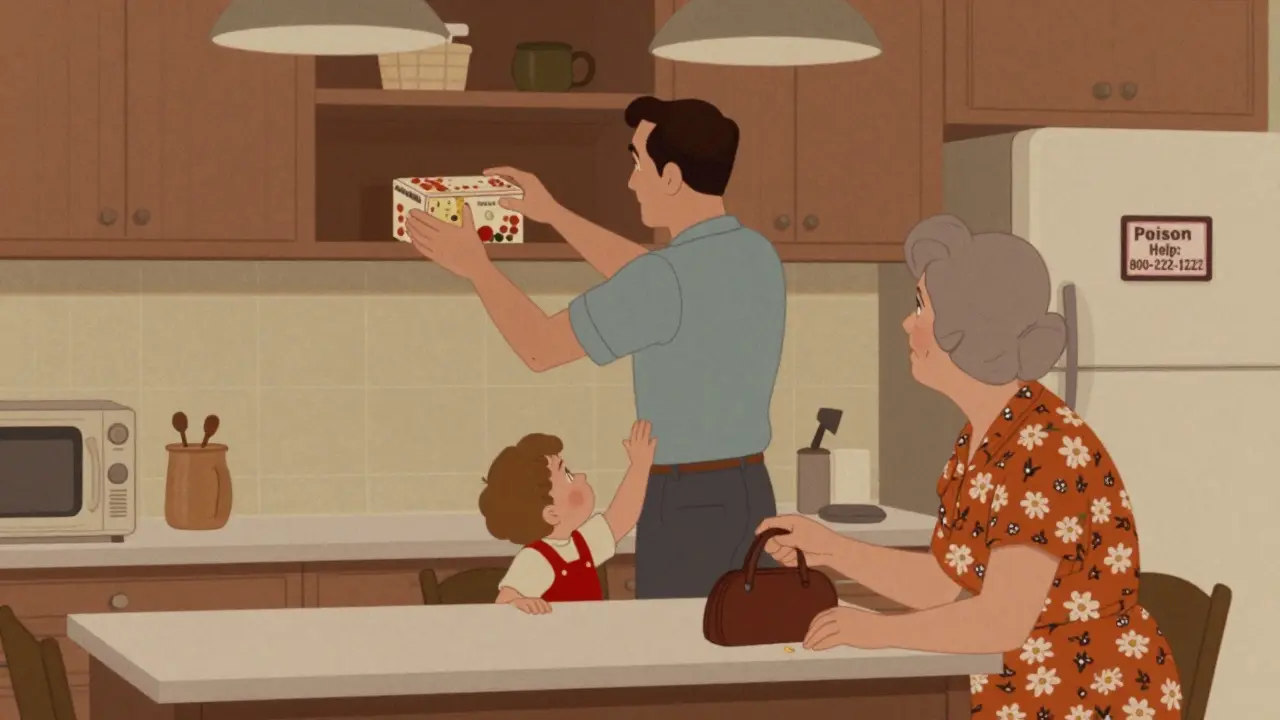
Most poisonings happen because medicine is left where kids can reach it. The CDC says 67% of incidents involving kids aged 1-4 could be prevented with proper storage.
Here’s what works:
- Lock all medicines in a cabinet with a childproof lock - not just a high shelf. Toddlers climb.
- Use a lock box that meets ASTM F2057-22 safety standards. Many pharmacies give them out for free.
- Never store medicine in purses, drawers, or on nightstands. A 2022 CDC survey found that 63% of grandparents keep medicine in their bags when kids visit.
- Keep all medicines - even vitamins and supplements - out of sight and out of reach. “Child-resistant” caps are not child-proof. Kids figure them out.
- Dispose of expired or unused meds properly. Don’t flush them. Use a drop-off location at your pharmacy.
One simple trick: “Up and away.” That means medicine should be stored above eye level and locked. If you can’t lock it, keep it in the highest cabinet in the kitchen or bathroom - not the bathroom vanity, where kids can pull it down.
What Parents and Teachers Need to Do Today
You don’t need a degree to teach this. You just need consistency.
At home: Spend 10-15 minutes a week practicing. Use pretend pills. Ask: “What do we do if we find this?” Praise them for saying, “I’ll give it to Mom.” Make it a game. Turn it into a “Medication Safety Patrol” mission.
At school: Ask if the school uses Generation Rx’s toolkit. If not, ask the nurse or principal to bring it in. Print out the free activity sheets from GenerationRx.org. Even one lesson can make a difference.
For all caregivers: Talk to grandparents, babysitters, and relatives. Send them a quick note: “Please keep all medicines locked up when [child’s name] visits. Even vitamins.”
And always, always keep the Poison Help number - 800-222-1222 - saved in every phone in the house. Ninety-one percent of calls about child poisonings happen within an hour of the incident. Speed saves lives.
The Bigger Problem: Teens and Prescription Misuse
Most programs stop at age 10. That’s a mistake.
Prescription drug misuse peaks in teens - and it’s now the second-leading cause of unintentional injury death for youth aged 15-19, according to CDC data. Teens are taking pills from home medicine cabinets because they think, “It’s not illegal if it’s in my house.”
There’s almost no curriculum for middle and high schoolers on this. Schools teach about drugs like marijuana or alcohol, but not about the pills in their own cabinets. That’s a gap we’re ignoring.
Experts like Dr. Stephen Wallace say we need to start teaching teens about proper storage, sharing, and the real dangers of taking someone else’s medicine - even if it’s for a headache or ADHD. The same rules that protect a 5-year-old should be reinforced for a 16-year-old.
Future programs are starting to address this. The CDC plans to expand its PROTECT Initiative to include teen-focused education in 2024. But until then, parents need to talk to their teens - not just about drugs, but about the pills on the shelf.
Final Thought: Safety Starts With You
Medication safety isn’t about scaring kids. It’s about giving them clear, simple rules they can remember. It’s about locking up what’s dangerous. It’s about never taking medicine in front of them. It’s about asking schools to teach it.
Every pill you lock away is one less chance for tragedy. Every time you say, “Medicine is not candy,” you’re teaching your child to protect themselves. And every time you check that the school has a plan, you’re helping protect other kids too.
This isn’t just about preventing ER visits. It’s about giving children the power to make safe choices - before they ever have to face a life-or-death moment.
At what age should I start teaching my child about medicine safety?
Start as early as age 3. At this age, children can learn to say, "I found a pill - I’ll give it to an adult" and avoid touching or tasting unknown pills. Simple, consistent messages work best. Role-playing with toy bottles helps reinforce the lesson without causing fear.
Is it safe to store medicine in a child-resistant bottle?
No. Child-resistant caps are not child-proof. Toddlers and preschoolers can open them with practice, especially if they see adults doing it. Always store medicine in a locked cabinet or lock box, even if the bottle has a child-resistant cap. The CDC reports that 86% of parents who use locked storage keep medicine safely - compared to only 29% who rely on caps alone.
Can I use a kitchen spoon to measure liquid medicine?
Never. Household spoons vary in size and can give doses that are 40% to 98% off from what’s prescribed. Always use the oral syringe or dosing cup that comes with the medicine. Most pharmacies give these out for free. If you lost it, ask for a new one - it’s safer than guessing.
What should I do if my child swallows medicine by accident?
Call Poison Help immediately at 800-222-1222. Don’t wait for symptoms. Don’t try to make them vomit. Don’t give them milk or food unless instructed. Ninety-one percent of poison calls happen within one hour of ingestion. Speed matters. Keep this number saved in every phone and posted near your landline.
Are there free resources schools can use to teach medication safety?
Yes. Generation Rx offers a free Elementary Toolkit with 12 classroom activities, 8 videos, and 15 printable sheets for grades K-5. The materials are designed for teachers with no medical training. You can download them at GenerationRx.org. The CDC and FDA also offer free posters and handouts for schools and homes.
Why is it dangerous to call medicine "candy"?
Calling medicine "candy" - even as a joke - creates a dangerous association in a child’s mind. A 2019 study of over 1,200 poisoning cases found that children exposed to this language were 220% more likely to ingest medicine without permission. Always say: "This is medicine. It’s not candy. Only take it when a grown-up says so."
How can I teach my child about medicine if they have a chronic condition like asthma or diabetes?
Use their condition as a teaching tool. Show them how their inhaler or insulin works, but always reinforce: "This medicine is only for you. Never touch someone else’s." Use labeled bottles with their name and picture. Let them help track doses with a chart. This builds responsibility without confusion. Generation Rx’s 2022 toolkit includes special activities for kids with chronic illnesses.
What Comes Next
Medication safety isn’t a one-time lesson. It’s a habit. Lock the cabinet. Say the words. Ask the school. Keep the number handy. Teach it again next year - because kids grow, and so do their risks.
The next time you hand your child a pill, pause. Ask yourself: "Would I give this to a stranger’s child?" If the answer isn’t a clear yes - then it’s not safe yet. Fix it. Teach it. Protect them.


Write a comment