

Statins & Antifungals Interaction Checker
Select your medications to check for dangerous interactions.
Why Some Antifungals Can Turn Your Statin Into a Hidden Danger
If you’re taking a statin for cholesterol and get a fungal infection that needs a pill instead of a cream, you might think it’s a simple fix. But here’s the catch: some antifungal pills can turn your statin into a ticking time bomb. The combination doesn’t just raise your risk of muscle pain-it can trigger a life-threatening condition called rhabdomyolysis, where muscle tissue breaks down and floods your kidneys with toxic debris.
This isn’t rare. In fact, it happens more often than doctors realize. In the U.S., over 39 million people take statins. Fluconazole alone is prescribed more than 5 million times a year. And when these drugs are mixed-especially with older azole antifungals like ketoconazole or posaconazole-the risk of muscle damage jumps tenfold.
How Azole Antifungals Disrupt Your Body’s Drug Processing
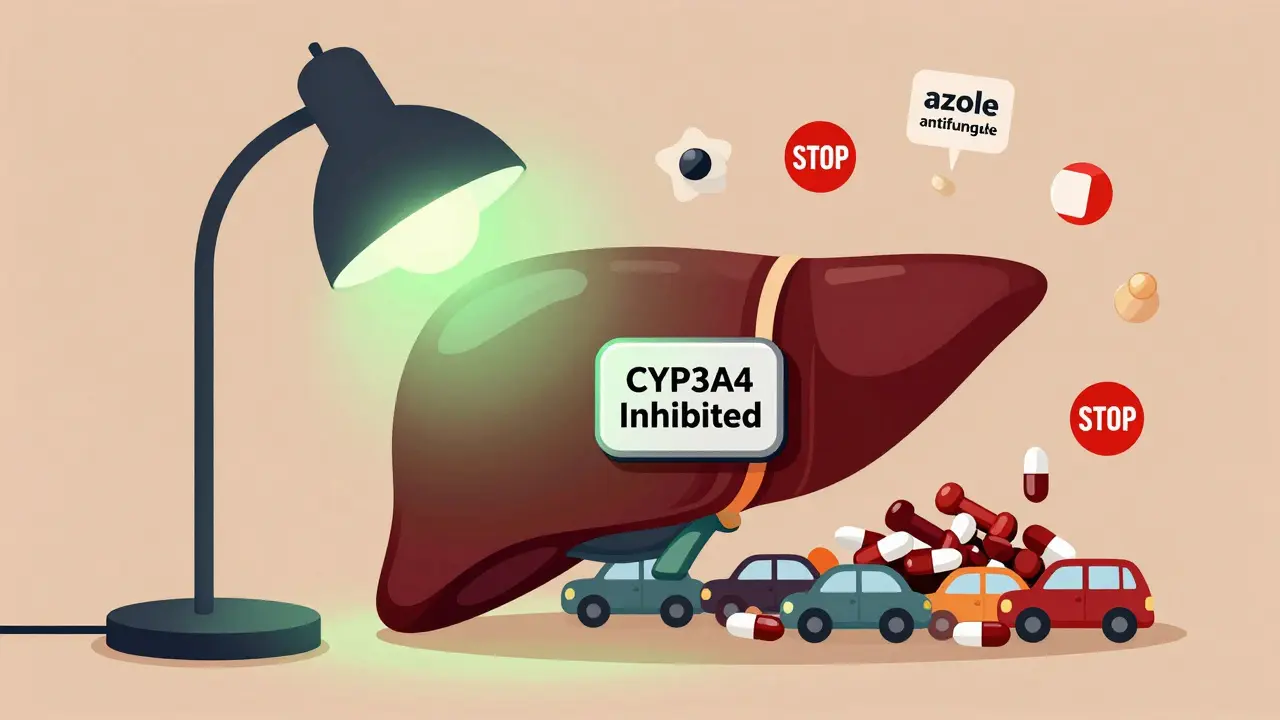
Systemic antifungals, especially the azole class, work by blocking a fungal enzyme called lanosterol 14-alpha-demethylase. But here’s the problem: that same enzyme is part of a family of human liver enzymes called cytochrome P450, specifically CYP3A4. This enzyme doesn’t just fight fungi-it breaks down about 30% of all prescription drugs, including most statins and immunosuppressants.
When azoles like itraconazole, voriconazole, or posaconazole are taken, they shut down CYP3A4 like flipping a switch. That means your statin doesn’t get broken down. It builds up in your blood. The result? Toxic levels. For example, posaconazole can make simvastatin levels spike 15 to 20 times higher than normal. That’s not a minor bump-it’s a medical emergency waiting to happen.
Not all azoles are the same. Fluconazole is weaker on CYP3A4 but still dangerous with certain statins. Ketoconazole is the worst offender-strongly inhibits CYP3A4 and is no longer recommended for systemic use in many countries. Posaconazole, while newer and less toxic to the liver, sticks around in your system for over a day, meaning its effects linger long after you stop taking it.
Which Statins Are Most at Risk?
Not all statins are created equal when it comes to interactions. The ones that rely heavily on CYP3A4 for breakdown are the most vulnerable:
- Simvastatin - Highest risk. Even a low dose can become deadly when mixed with azoles.
- Atorvastatin - Also metabolized by CYP3A4. Risk is high, especially at doses above 20 mg.
- Lovastatin - Same profile as simvastatin. Avoid entirely during azole treatment.
These three are the most common culprits in drug interaction cases. If you’re on any of them and need an antifungal, your doctor should stop them immediately.
On the other hand, some statins barely touch CYP3A4:
- Pravastatin - Mostly cleared by the kidneys, not the liver. Safer, but not risk-free.
- Rosuvastatin - Minimal CYP3A4 use. Still, it’s transported into liver cells by OATP1B1, which ketoconazole blocks. So even this one needs caution.
- Fluvastatin - Uses CYP2C9, not CYP3A4. Lower interaction risk.
Bottom line: if you’re on simvastatin, atorvastatin, or lovastatin, don’t take ketoconazole, itraconazole, or posaconazole. Period.
Immunosuppressants Make the Risk Even Worse
If you’ve had a kidney, liver, or heart transplant, you’re probably on cyclosporine, tacrolimus, or sirolimus. These drugs are lifesavers-but they’re also CYP3A4 inhibitors. So now you’ve got two drugs shutting down your liver’s ability to process statins: the antifungal and the immunosuppressant.
Studies show that in transplant patients, combining statins with cyclosporine can increase statin levels by 3 to 20 times. That’s why up to 25% of transplant patients on statins develop muscle pain or weakness. And when creatine kinase (CK) levels hit over 10,000 U/L, you’re looking at rhabdomyolysis-a condition that can lead to kidney failure and death.
One case from a Canadian hospital in 2024 involved a 58-year-old man on tacrolimus and simvastatin who developed severe muscle pain after starting fluconazole for a yeast infection. His CK level was 14,000 U/L. He spent five days in the ICU. He survived, but barely.
Doctors in transplant clinics now treat this combo like a red flag. If you’re on immunosuppressants and need a statin, you’re usually started on the lowest possible dose-and monitored closely. CK levels are checked every 2-4 weeks. If they rise above 10 times the normal limit, the statin is stopped immediately.
What Should You Do If You Need an Antifungal?
Here’s what actually works in real clinical practice:
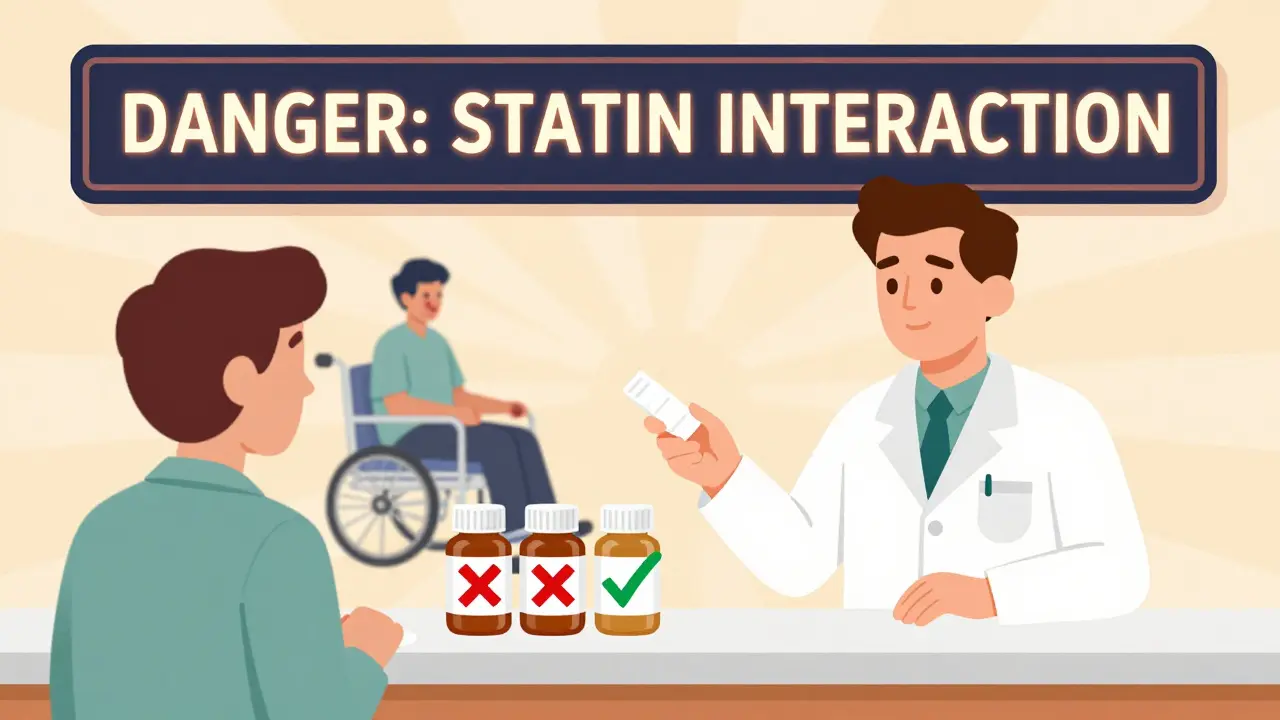
- Stop high-risk statins. If you’re on simvastatin, atorvastatin, or lovastatin, pause them before starting ketoconazole, itraconazole, or posaconazole. Don’t wait for symptoms.
- Switch to a safer statin. If you still need cholesterol control, switch to pravastatin (10-40 mg daily) or rosuvastatin (5-20 mg daily). Even then, start low.
- Use twice-weekly dosing. For patients who absolutely need simvastatin (e.g., severe familial hypercholesterolemia), some experts allow 10 mg twice a week during azole therapy. But this should only be done under close supervision.
- Monitor CK and symptoms. Muscle pain, weakness, or dark urine? Call your doctor immediately. Don’t wait. These are early signs of muscle breakdown.
- Wait after stopping the antifungal. Posaconazole stays in your system for 24-30 hours. Don’t restart your statin until at least 3 days after your last antifungal dose. For ketoconazole, wait 5-7 days.
And here’s something many patients don’t realize: even over-the-counter antifungals can be dangerous. Some topical creams and shampoos contain ketoconazole. If you’re using them on large areas of skin or for long periods, your body can absorb enough to cause an interaction. Always tell your pharmacist you’re on statins or immunosuppressants before buying any antifungal product.
What’s Changing in 2026? Newer Options Are Safer
The good news? The field is evolving. Newer antifungals like isavuconazole and olorofim are designed to avoid CYP3A4 inhibition entirely. Isavuconazole only moderately affects the enzyme-so it’s safer than older azoles. Olorofim, still in late-stage trials, works by blocking a completely different fungal pathway. Early data shows almost no drug interactions.
Pharmacies are catching up too. In 87% of academic medical centers in North America, pharmacists now run automated checks before dispensing azole antifungals. If you’re on a statin or immunosuppressant, the system flags it and requires a pharmacist to confirm it’s safe. That’s cut high-risk combinations by 63% in those settings.
But community pharmacies? They’re still playing catch-up. A 2025 survey in British Columbia found that 1 in 4 patients on statins were still being prescribed fluconazole without any warning or dose adjustment. That’s why you can’t rely on the system-you have to be your own advocate.
What About Genetic Risk?
Not everyone reacts the same way. About 12% of people carry a genetic variation in the SLCO1B1 gene, which controls how statins enter liver cells. If you have this variant and take a statin with a CYP3A4 inhibitor, your risk of muscle damage is 2 to 3 times higher than average.
Right now, genetic testing for this isn’t routine. But if you’ve had unexplained muscle pain on statins before-or if a close relative had rhabdomyolysis-it’s worth asking your doctor about it. Some clinics now offer testing before starting high-risk combinations.
Final Advice: Don’t Guess. Ask.
Drug interactions like these aren’t theoretical. They cause real harm. Every year, dozens of people end up in the hospital because someone assumed a fungal infection was harmless to treat. But it’s not.
Before you take any oral antifungal-whether it’s for athlete’s foot, nail fungus, or a yeast infection-ask yourself: Am I on a statin or an immunosuppressant? If yes, don’t start the antifungal until you’ve talked to your doctor or pharmacist. Bring your full medication list. Write down the names. Ask: "Which statin is safest with this antifungal? Should I stop my current one?"
There’s no shame in asking. The real risk is assuming it’s fine.
Can I take fluconazole with my statin?
It depends. Fluconazole is a moderate CYP3A4 inhibitor and a strong CYP2C19 inhibitor. If you’re on atorvastatin, simvastatin, or lovastatin, it’s risky. Pravastatin or rosuvastatin are safer choices, but even then, your doctor should lower the dose and monitor you. Never take fluconazole with simvastatin without explicit approval.
What are the signs of rhabdomyolysis?
The main signs are severe muscle pain, weakness, and dark brown or tea-colored urine. You might also feel unusually tired or have nausea. If you notice any of these while taking a statin and an antifungal together, stop the statin and seek medical help immediately. Delaying can lead to kidney failure.
Why can’t I just lower my statin dose instead of stopping it?
Lowering the dose doesn’t eliminate the risk. Even a 5 mg dose of simvastatin can become toxic when combined with a strong CYP3A4 inhibitor like posaconazole. The interaction isn’t about the amount-it’s about how your body can’t break it down at all. That’s why stopping is the only safe option.
Is there a safer antifungal than azoles?
Yes. For some infections, echinocandins like caspofungin are used intravenously and don’t interact with statins. For mild cases, topical treatments (creams, sprays) are often enough. Newer oral antifungals like isavuconazole are much safer than ketoconazole or itraconazole. Olorofim, still in trials, shows no CYP3A4 interaction at all.
How long should I wait after stopping an antifungal before restarting my statin?
For most azoles, wait 3-5 days. But for posaconazole, wait at least 7 days because it stays in your system longer. For ketoconazole, wait 7-10 days. Always check with your doctor-your individual metabolism and the specific drugs matter.


Write a comment