
HAS-BLED Bleeding Risk Calculator
Assess Your Bleeding Risk
The HAS-BLED score helps determine bleeding risk when combining antidepressants with blood thinners. This tool uses criteria from clinical guidelines published in the Journal of the American College of Cardiology.
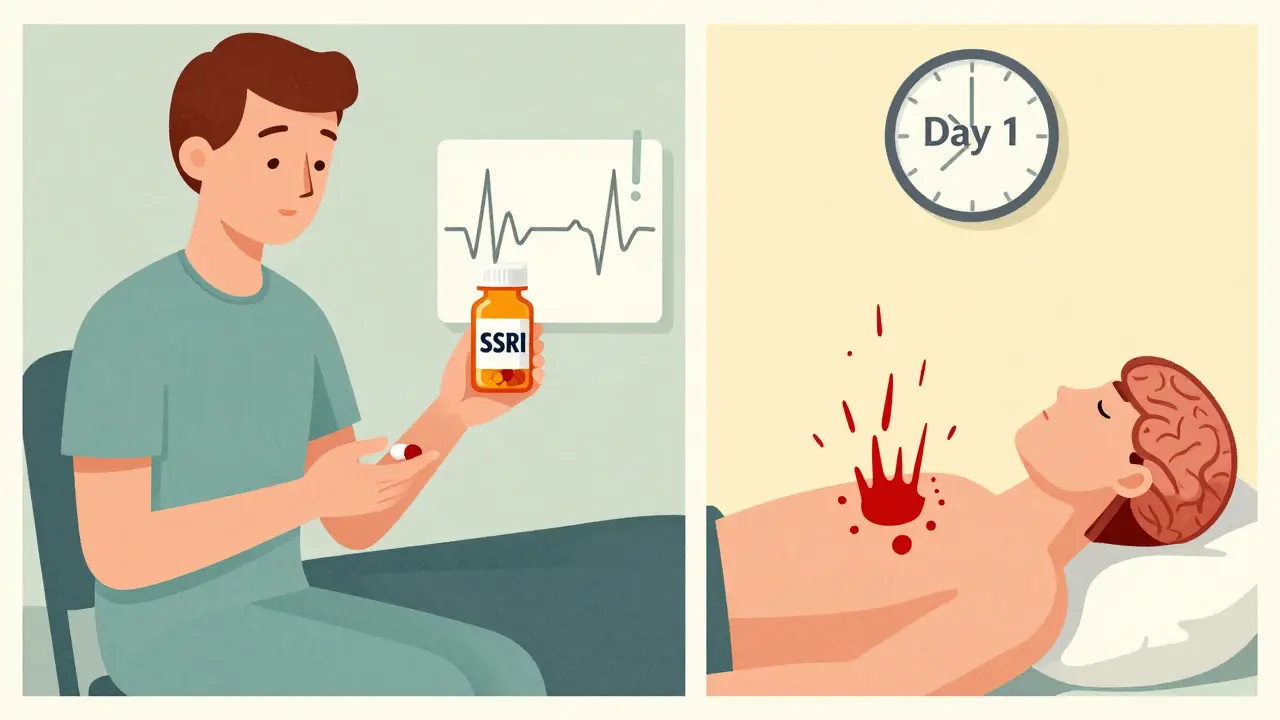
Combining SSRIs with anticoagulants is more common than you think. About 39% of people on blood thinners for atrial fibrillation also have depression or anxiety-and SSRIs are the go-to treatment. But here’s the catch: this combo can increase your risk of serious bleeding. Not a little. Not rarely. SSRIs with anticoagulants raise the chance of major bleeding by 33%, according to the largest study ever done on this interaction, published in JAMA Network Open in March 2024. That’s not theoretical. That’s real. And it happens fast.
Why This Interaction Happens
SSRIs don’t thin your blood like warfarin or rivaroxaban do. Instead, they mess with your platelets. Platelets are the tiny cells in your blood that clump together to stop bleeding. They need serotonin to work properly. SSRIs block serotonin from re-entering platelets, which drains their stores. Without enough serotonin, platelets can’t stick together well. Studies show this cuts platelet aggregation by 30-40%. That’s like having a weaker glue holding your blood clots together.This isn’t about liver enzymes or drug metabolism. A 2025 study from Mokhtarian et al. tested this directly. They looked at thrombin generation-the key step in clot formation-and found SSRIs like citalopram had zero effect on clotting time, peak thrombin, or total clot volume. The problem isn’t your coagulation cascade. It’s your platelets. And that’s why bleeding happens even when your INR or DOAC levels are perfect.
When the Risk Is Highest
The danger isn’t constant. It spikes in the first 30 days after starting both drugs together. During that window, your bleeding risk jumps 33%. After six months, it drops back toward baseline. Why? Your body adapts. Platelet turnover replaces damaged ones. But in those first weeks, your system is still adjusting. That’s when most bleeding events occur.Most bleeding happens in the gut-58% of cases. That’s stomach ulcers, colon bleeds, rectal bleeding. Intracranial hemorrhage makes up 17%. These aren’t rare accidents. They’re predictable outcomes of a known interaction. If you’re on warfarin or a DOAC and start sertraline or escitalopram, your bleeding risk goes from 1.8 events per 100 person-years to 2.4. That’s 6 extra bleeds per 1,000 people each year. That’s not negligible. That’s a clinical red flag.
Not All Anticoagulants Are Equal
Warfarin and DOACs behave differently when mixed with SSRIs. The 2024 study showed warfarin users had a 28% increased bleeding risk with SSRIs. DOAC users? Only 22%. That difference wasn’t statistically significant, but it’s consistent across multiple studies. Why? Warfarin’s narrow therapeutic window and sensitivity to diet, alcohol, and other drugs make it more volatile. DOACs are more predictable. That’s why many cardiologists now prefer DOACs for patients who also need antidepressants.Still, no DOAC is risk-free. Rivaroxaban, apixaban, dabigatran-all carry the same platelet-based risk when paired with SSRIs. The difference is in stability, not mechanism.
Are Some SSRIs Safer Than Others?
You might think stronger SSRIs like paroxetine would be riskier. After all, they block serotonin reuptake more powerfully. But the data says otherwise. In the same 2024 study, paroxetine and escitalopram showed identical bleeding risk (IRR 1.33). Same with sertraline, fluoxetine, citalopram. The potency of serotonin reuptake inhibition doesn’t predict bleeding risk. What matters is that you’re taking an SSRI at all.Earlier studies, like the 2018 ROCKET AF analysis, suggested rivaroxaban might be safer than warfarin with SSRIs-but those results weren’t statistically significant. The newer, larger data overrides those older signals. Bottom line: if you’re on an SSRI, your bleeding risk goes up, no matter which one.
What About Other Antidepressants?
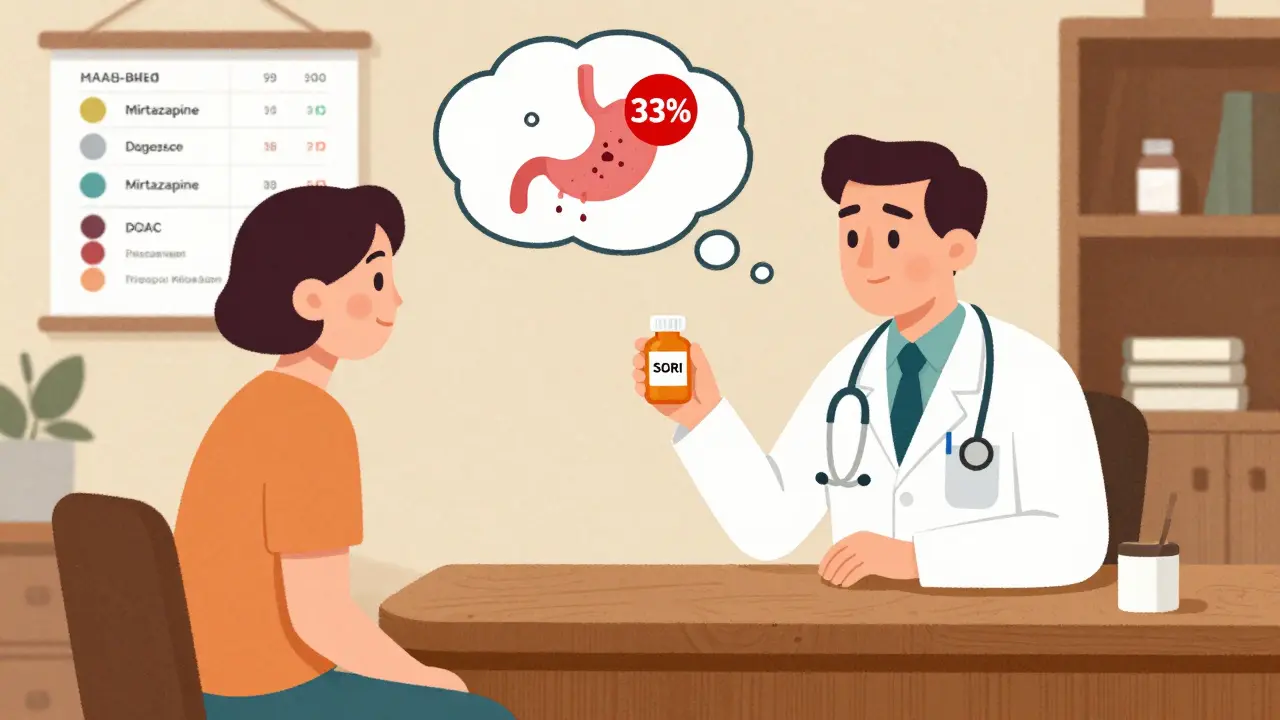
You don’t have to stay on an SSRI. If you’re at high risk for bleeding-older, on multiple blood thinners, with a history of ulcers or falls-there are better options. Mirtazapine and bupropion don’t affect platelets. They’re not SSRIs. They don’t deplete serotonin in platelets. That’s why the European Heart Rhythm Association recommends them for patients with a HAS-BLED score of 3 or higher.But here’s the catch: 87% of anticoagulated patients with depression still get SSRIs. Why? Because they work. They’re effective. They’re well-tolerated. And many doctors don’t realize the bleeding risk is this real. A 2022 audit found 68% of dangerous SSRI-anticoagulant combos happen in primary care, where depression is treated without input from cardiologists or pharmacists.
What Should You Do?
If you’re on an anticoagulant and your doctor wants to start an SSRI, ask these questions:- Is this the best antidepressant for my bleeding risk?
- Can we try mirtazapine or bupropion instead?
- Will I need more frequent blood tests?
- What signs of bleeding should I watch for?
Monitoring is key. For warfarin users, INR should be checked twice a week for the first month. Everyone should get a complete blood count (CBC) and fecal occult blood test at baseline and monthly for the first three months. If you notice black stools, unexplained bruising, nosebleeds that won’t stop, or headaches with vision changes-call your doctor immediately. Don’t wait.
The Bigger Picture
This isn’t just about one drug combo. It’s about how we treat mental health in people with chronic physical illness. Depression is common in heart disease. But we often treat it without considering the body’s other systems. The American College of Cardiology calls this one of the most common yet underaddressed safety issues in cardiovascular care. They’re now developing decision tools that combine your HAS-BLED score with your depression severity to guide antidepressant choice.The FDA updated anticoagulant labels in 2019 and again in January 2025 to warn about SSRI interactions. The American Heart Association has had guidance since 2017. Yet, this interaction is still overlooked. Why? Because depression is invisible. Bleeding is silent until it’s not.
The economic cost is real too. Each major bleeding event costs an average of $18,750. In the U.S. alone, this interaction adds $1.2 billion annually to healthcare spending. That’s preventable. That’s fixable.
The PRECISION-AF trial, now enrolling 5,000 patients, will compare SSRIs to non-SSRI antidepressants in anticoagulated atrial fibrillation patients. Results come in late 2026. But we don’t need to wait. The evidence is already strong enough to change practice.


Write a comment