

Every spring and summer, millions of people wake up with itchy eyes, a runny nose, and that constant feeling of being stuffed up-not because they’re sick, but because the air is full of pollen. If you’ve ever canceled a hike, cut a run short, or spent an afternoon indoors just to avoid sneezing fits, you know how disruptive pollen can be. The good news? You don’t have to guess when it’s safe to go outside. Pollen forecasting gives you a clear, science-backed way to plan your outdoor time around the worst days.
What Pollen Forecasting Actually Tells You
Pollen forecasting isn’t just a weather app with a flower icon. It’s a detailed prediction of how many pollen grains are floating in the air, measured in grains per cubic meter. Think of it like an air quality report, but for allergens. A count of 50 grains/m³ is considered low. Once it hits 150, you’re in the high range-and that’s when most allergy sufferers start feeling it. For ragweed, even 20 grains/m³ is considered high. These numbers come from real-world monitoring. Stations across North America and Europe use greased rods that spin in the air, collecting pollen over 24 hours. That data gets fed into models that combine temperature, wind, humidity, and even satellite images of plant growth. Some systems, like BreezoMeter’s, now use over 200 data points per location, including traffic patterns and land use, to predict pollen levels with 1.5-kilometer accuracy.When Pollen Hits Its Peak-And When It Doesn’t
Pollen doesn’t just show up randomly. It follows a strict seasonal calendar-and a daily rhythm.- Tree pollen (like oak, birch, maple) peaks from late February to April, with the worst days usually between March 15 and April 30. It’s highest in the morning, right after the dew dries-between 5 and 10 a.m.
- Grass pollen takes over from April to early June, hitting its peak around mid-May. This type peaks midday, from 10 a.m. to 4 p.m., when the sun is strongest and winds pick up.
- Weed pollen, especially ragweed, is the big culprit in late summer. It starts ramping up in August and doesn’t fade until frost. Ragweed pollen is strongest in the late afternoon and early evening, from 4 to 8 p.m.
How Weather Changes Everything
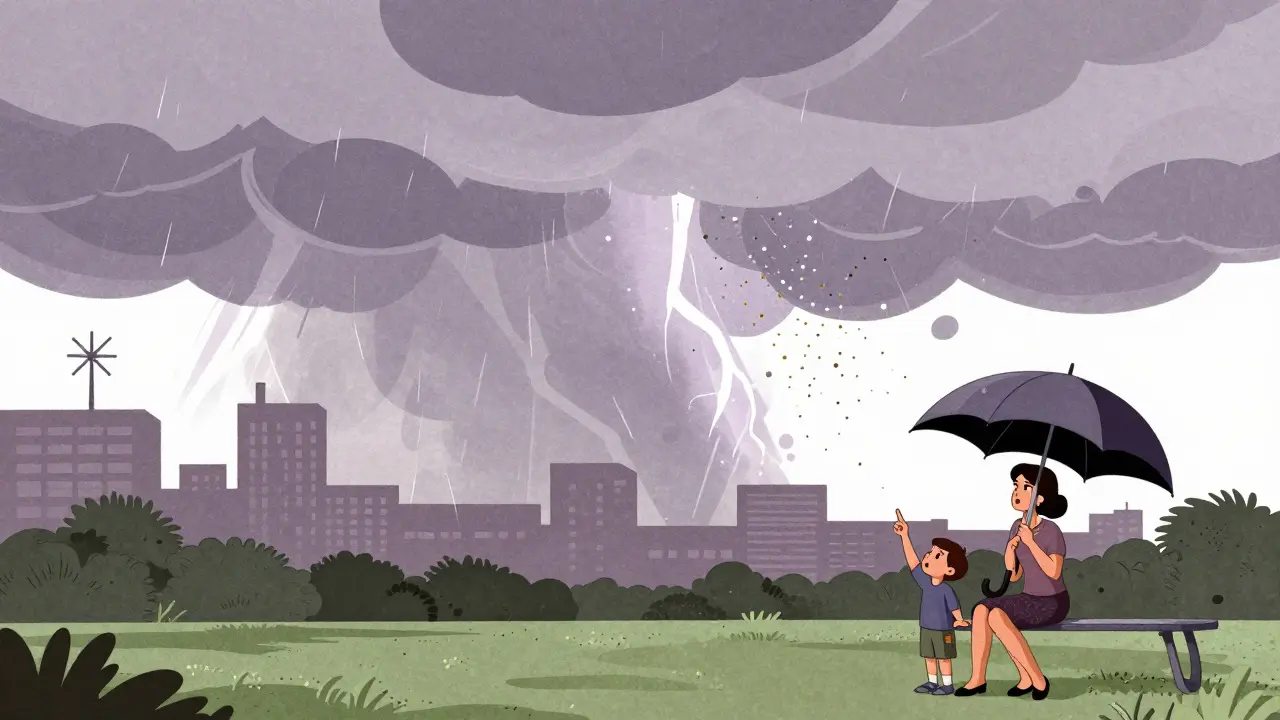
Rain is your friend. A light shower-just 0.1 inch-can knock pollen levels down by 30-50% within two hours. That’s why the day after rain is often the best day to get outside. But be careful: the next dry, windy day can send pollen soaring again. Winds over 10 mph can increase airborne pollen by 40%. And if it’s hot and dry? Expect counts to jump. For every 2-3°C rise in temperature, pollen levels can go up 15-20%. Thunderstorms are a wildcard. They can trigger something called “thunderstorm asthma,” where pollen grains burst open in the moisture, releasing tiny allergen particles deep into the lungs. In Melbourne, Australia, one storm in 2016 sent ER visits for asthma soaring by 300% in under 30 minutes. No forecast system today can reliably predict these events, so if a storm is coming, err on the side of caution.
Which Forecasting Tools Actually Work?
Not all apps are created equal. Here’s what’s out there-and what you should trust.- BreezoMeter is the most accurate. It’s used by Apple Health, major sports teams, and school districts. It gives you 5-day forecasts with 82% accuracy and pinpoints levels down to 1.5 km. It’s not free-$0.0005 per API call-but the precision is worth it if you’re serious about managing symptoms.
- Pollen.com is free and has been around since 2004. It covers 10 pollen types across the U.S. with 75% accuracy, but its resolution is only 10 km. That means it might say “low” in your neighborhood while your actual street has “high” levels.
- WeatherBug and Copernicus (CAMS) are solid for Europe and parts of North America. CAMS is backed by the European Union and has 87% accuracy, but it doesn’t have a user-friendly app.
What You Should Do-Step by Step
You don’t need to be an expert. Just follow this simple routine:- Check the forecast daily during peak season (February-October). Make it part of your morning routine, like checking the weather.
- Know your triggers. Are you allergic to tree pollen? Grass? Ragweed? Most people mix them up. A 2023 survey found 37% of users track the wrong type. Test with an allergist if you’re unsure.
- Time your outdoor time. Shoot for early morning (5-7 a.m.) or evening (7-9 p.m.). Avoid midday, especially on dry, windy days.
- Wait after rain. The day after rain is often your best bet. But avoid going out right after a storm if thunderstorms are common in your area.
- Track your symptoms. Use a notebook or a simple app to note how you feel each day. Over time, you’ll start seeing patterns. One Reddit user, u/AllergyWarrior89, cut their antihistamine use in half by switching to evening runs.
Why This Matters Beyond Comfort
This isn’t just about avoiding sneezes. Uncontrolled pollen exposure can worsen asthma, disrupt sleep, and even affect school and work performance. A Dutch study showed that people who planned their days around pollen forecasts had 22% fewer emergency room visits during peak season. Schools in 22 U.S. districts now adjust recess and sports schedules based on pollen data. Even professional teams like Manchester United and the New England Patriots use it to time training. Climate change is making this more important than ever. Since 1990, the U.S. pollen season has grown by over 20 days, and pollen concentrations have jumped 21%. That means your allergy season is longer-and more intense. Forecasting isn’t a luxury anymore. It’s a tool for staying healthy.What’s Coming Next
The next big leap is here. In 2025, the European Space Agency is launching PollenSat-a satellite designed to map pollen types from space with 5-km resolution. AI models funded by the NIH are being trained to predict thunderstorm asthma. And Apple Health is now integrating pollen exposure data with heart rate and breathing patterns to give personalized alerts. But you don’t have to wait. Start today. Pick one app. Check it for a week. Adjust your routine. You might be surprised how much better you feel.What time of day has the lowest pollen count?
Pollen counts are typically lowest between 5 a.m. and 7 a.m., and again between 7 p.m. and 9 p.m. Tree pollen peaks in the early morning after dew dries, grass pollen peaks midday, and ragweed peaks in the late afternoon. Avoiding outdoor activity between 10 a.m. and 6 p.m. during peak season can cut your exposure by nearly half.
Can rain really reduce pollen levels?
Yes. Even a light rain of 0.1 inch can wash pollen out of the air, reducing counts by 30-50% within two hours. The best outdoor days are often the day after a rainstorm. But avoid going out during or right after a thunderstorm-those can trigger dangerous spikes in airborne allergens due to pollen rupture.
Are free pollen apps accurate enough?
Free apps like Pollen.com are about 75% accurate but only give data at 10-kilometer resolution. That means they might miss local hotspots. For better precision, use two free sources to cross-check, or consider BreezoMeter, which offers 1.5-km accuracy and 82% forecast accuracy. If you’re serious about managing symptoms, the extra precision is worth it.
Why do pollen counts vary so much between neighborhoods?
Urban microclimates play a big role. Parks, trees near your home, wind direction, and even pavement can trap or spread pollen differently. One street might have high birch pollen because of a row of trees, while the next block has low counts. Only advanced systems like BreezoMeter and WeatherBug account for this. If you’re sensitive, track your own symptoms to find your personal “safe zones.”
Should I stop exercising during high pollen days?
No-you just need to adjust when you exercise. Running or biking during low-pollen hours (early morning or evening) can reduce symptoms by up to 45%. A 2021 study found marathon runners who trained between 7-9 a.m. during grass pollen season had far fewer breathing issues than those who ran at noon. Don’t give up your routine; optimize it.
Is pollen forecasting useful in Canada?
Absolutely. In Vancouver and across Canada, tree pollen (especially birch and alder) peaks in April, grass pollen in May and June, and ragweed in August. Canadian weather patterns are well-covered by BreezoMeter and the Copernicus Atmosphere Monitoring Service. Many Canadian allergy sufferers use these tools daily during spring and fall to plan walks, gardening, and outdoor family time.


Write a comment