
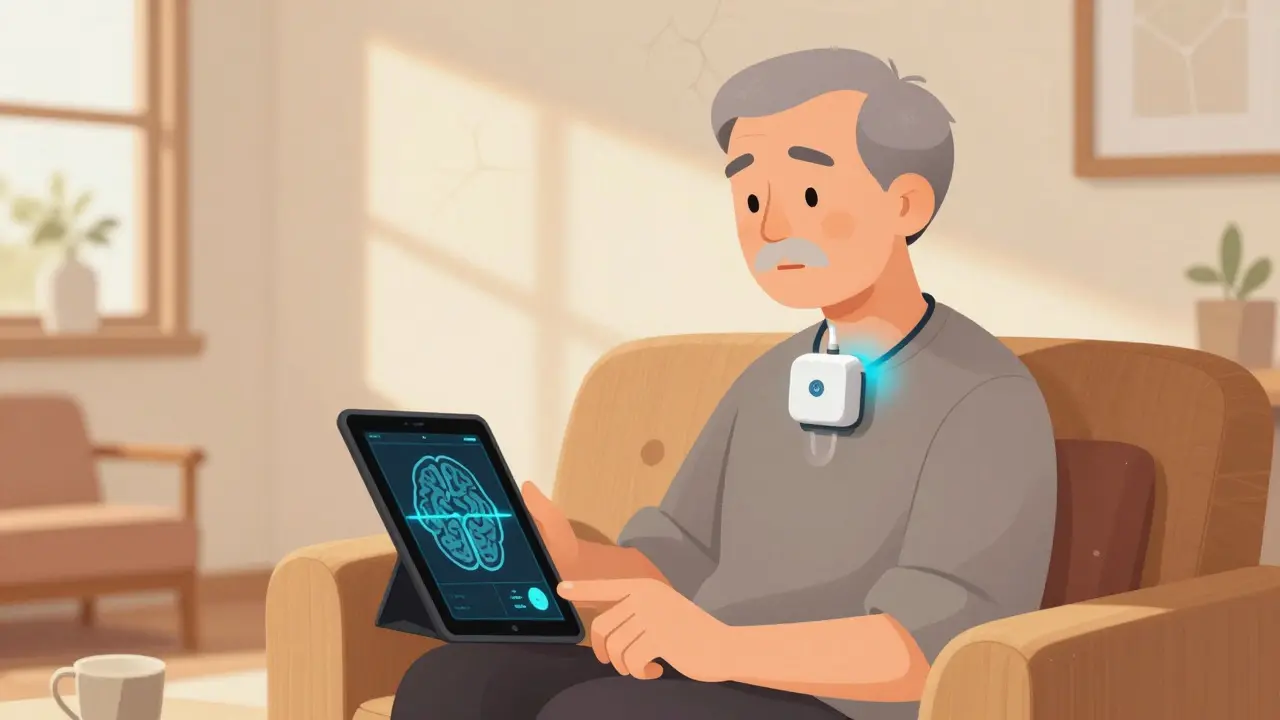
For many people with Parkinson’s disease, medication like levodopa works well at first. But over time, the effects wear off faster, unwanted movements (dyskinesias) start popping up, and days become a cycle of ON and OFF periods. That’s where deep brain stimulation (DBS) comes in - not as a cure, but as a powerful tool to regain control when drugs alone aren’t enough.
What Exactly Is Deep Brain Stimulation?
DBS is a surgical treatment that uses mild electrical pulses to calm overactive brain circuits causing Parkinson’s symptoms. It’s not a new idea - the first successful use for Parkinson’s happened in the late 1990s - but today’s systems are far more advanced. Tiny electrodes, thinner than a pencil lead, are placed deep inside the brain. These connect to a small battery-powered device, usually implanted under the skin near the collarbone or abdomen. The device sends continuous, adjustable pulses to specific brain targets, blocking the faulty signals that cause tremors, stiffness, and slowness.
Modern devices like Medtronic’s Percept™ PC and Boston Scientific’s Vercise™ Genus™ don’t just zap the brain - they listen too. They record brain activity in real time, especially the abnormal beta wave patterns (13-35 Hz) linked to Parkinson’s motor symptoms. Some even adjust stimulation automatically based on what the brain is doing. This is called closed-loop DBS, and early data from the INTREPID trial shows it gives 27% better symptom control than older systems that just pump out constant pulses.
Which Parts of the Brain Are Targeted?
Not all brain targets are the same. The two most common are the subthalamic nucleus (STN) and the globus pallidus interna (GPi). Choosing between them isn’t just about which one works better - it’s about what matters most to the patient.
- STN tends to let people cut their levodopa dose by 30-50%. That means fewer drug side effects like nausea, hallucinations, or sudden drowsiness. But it can sometimes make thinking, speech, or mood worse - especially in people already at risk for cognitive changes.
- GPi is better at reducing dyskinesias (up to 70% improvement) without needing to lower medication as much. It’s also less likely to affect thinking or mood. For someone with severe involuntary movements or a history of depression, GPi might be the safer pick.
The VA/NINDS CSP #468 trial found both targets improved movement by about the same amount - roughly half. But GPi had clearer advantages for dyskinesia and cognitive safety. That’s why many experts now recommend GPi for older patients or those with existing memory or mood issues.
Who Is a Good Candidate for DBS?
DBS isn’t for everyone. Even if you have Parkinson’s, you might not qualify. The criteria are strict - and they’re based on decades of research, not guesswork.
First, you need to have idiopathic Parkinson’s - not atypical parkinsonism like progressive supranuclear palsy (PSP) or multiple system atrophy (MSA). Those conditions don’t respond to DBS. In fact, less than 10% of those patients see any benefit.
Second, you must have a clear, strong response to levodopa. If your tremors or slowness improve by more than 30% after taking your usual dose, you’re likely a good fit. If your symptoms barely budged, DBS won’t help much either.
Third, you need to have had Parkinson’s for at least five years. Why? Because early on, meds work fine. DBS is meant for when those meds start failing - not as a first-line treatment. Though new trials like EARLYSTIM-2 are now testing DBS in patients with just 3 years of disease, it’s still not standard.
Fourth, your thinking and mood must be stable. A score above 24 on the MMSE or 21 on the MoCA is the usual cutoff. If you have dementia, severe depression, or uncontrolled anxiety, DBS can make things worse. A full neuropsychological exam - usually 4 to 6 hours - is required before surgery.
Fifth, you need to be physically healthy enough for brain surgery. No major heart or lung disease. No uncontrolled diabetes. No history of strokes or brain bleeds. And you need to be willing to commit to months of follow-up visits for programming adjustments.
What Happens During the Process?
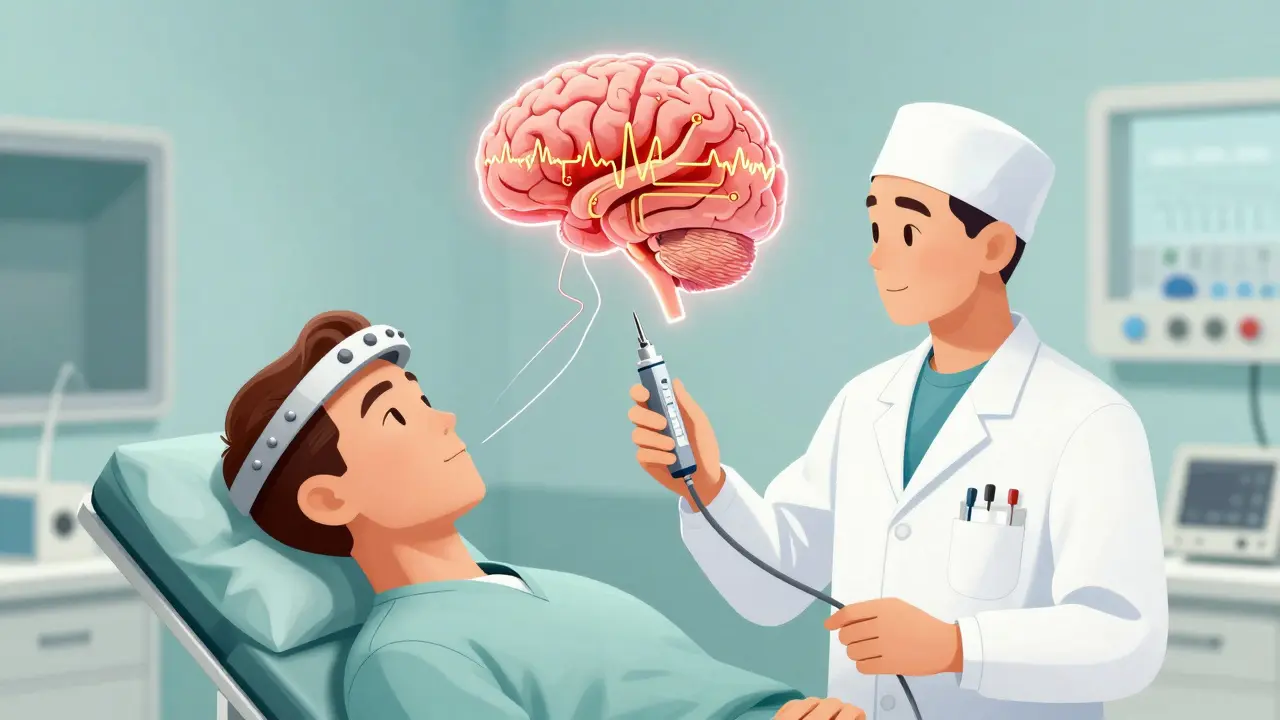
The journey to DBS takes 3 to 6 months. It starts with a movement disorder specialist confirming your diagnosis and levodopa response. Then comes the neuropsych test, a high-resolution 3T MRI to map your brain, and a meeting with a neurosurgeon and a DBS coordinator.
The surgery itself is done while you’re awake - not because it’s painful, but because the team needs you to move, talk, and respond so they can find the exact spot to place the electrode. A frame is attached to your head, and tiny wires record brain signals as the surgeon drills through the skull. The whole thing takes 3 to 6 hours. Most people go home the next day.
But the surgery is just the beginning. The device doesn’t turn on right away. It takes 4 to 6 weeks for swelling to go down. Then, the real work starts: programming. This isn’t like adjusting a hearing aid. It’s a slow, trial-and-error process that can take 6 to 12 months. You’ll need to keep a symptom diary, note when you take meds, and show up every few weeks. Some centers have dedicated DBS coordinators who help with this. Others? You’re on your own.
What Are the Real Risks?
DBS is safe - but it’s not risk-free. About 1-3% of patients have a brain bleed during surgery. That’s rare, but serious. About 5-15% will have hardware problems: an infection under the skin, a wire that breaks or moves, or a battery that fails early. Revisions are common - about 1 in 10 people need another surgery within 5 years.
Then there are the subtle changes. Some people get worse at finding words, planning tasks, or remembering names. One Reddit user said, “My tremors are gone, but I struggle with executive function - planning meals takes 3x longer than before.” That’s not rare. And it’s not always reversible.
And then there’s the cost. In the U.S., DBS can run $50,000 to $100,000. Medicare covers it - but private insurers often drag their feet, requiring months of documentation proving you’ve tried and failed all other options. Even after approval, follow-up visits, battery replacements, and programming sessions add up.
What About the Alternatives?
There are other options. Focused ultrasound (like Exablate Neuro) can treat tremor without surgery. But it only works on one side of the brain and doesn’t help stiffness or slowness. It’s also not approved for widespread use in Parkinson’s - just tremor-dominant cases.
Lesioning procedures (like pallidotomy) destroy a small part of the brain to stop symptoms. They’re permanent. And once you do it, you can’t undo it. DBS is reversible. If it doesn’t help, you can turn it off. If your needs change, you can reprogram it.
For most people with advanced Parkinson’s and clear levodopa response, DBS still wins. But it’s not a magic bullet. It doesn’t stop the disease. It doesn’t fix balance problems or speech issues. It doesn’t cure depression. It only helps the motor symptoms that respond to levodopa.
Why So Few People Get It
Here’s the sad part: only 1-5% of people who meet the criteria for DBS actually get it. Why? Because most neurologists don’t refer patients early enough - or at all. The Parkinson’s Foundation says DBS is markedly underutilized. Many patients are never even screened. Others are told, “It’s too risky,” or “You’re too old.” But age isn’t the issue - health and response are.
And some patients have unrealistic expectations. One forum post read: “I thought DBS would stop disease progression - it doesn’t.” That’s a common misunderstanding. DBS treats symptoms. It doesn’t slow the underlying brain damage. If you’re hoping for a cure, you’ll be disappointed.
What to Expect After Surgery
Most people who qualify and stick with the process see dramatic improvements. In the EARLYSTIM trial, patients who got DBS early had a 23-point improvement in quality of life scores - twice as much as those who kept only medication. Many go from being housebound to driving, cooking, or playing with grandkids again.
But it’s not instant. It takes time. You’ll need patience. You’ll need to track your symptoms. You’ll need to show up for appointments. And you’ll need to accept that some changes - like a little trouble with word-finding - might stick around.
The key is choosing the right center. High-volume centers - those doing over 50 DBS procedures a year - have 20% fewer complications. If your hospital does fewer than 10 a year, ask if they refer patients to a larger program. Don’t settle for less.
The Future of DBS
The field is moving fast. Researchers are now looking at using genetic markers - like LRRK2 mutations - to predict who will respond best. Some are testing DBS for non-motor symptoms like depression and apathy. Others are linking DBS devices to smartwatches that track tremors and automatically adjust stimulation.
One day, DBS might be offered even earlier - maybe after just 3 years of Parkinson’s. But for now, the rule is simple: if your motor symptoms respond to levodopa, you’re still active, your mind is clear, and you’re ready to commit to the long haul - then DBS could be the best thing you’ve ever done for your quality of life.
Is DBS a cure for Parkinson’s disease?
No, DBS is not a cure. It doesn’t stop Parkinson’s from progressing. It only helps manage motor symptoms - like tremors, stiffness, and slowness - that respond to levodopa. It won’t fix balance problems, speech issues, or cognitive decline caused by the disease itself.
How long does the DBS battery last?
Non-rechargeable batteries last about 3 to 5 years and require replacement surgery. Rechargeable systems, like those in Medtronic’s Percept™ PC or Boston Scientific’s Vercise™ Genus™, last 9 to 15 years. But even rechargeable ones need regular charging - usually every few days - and can still need replacement if the device fails.
Can DBS help with speech or balance problems?
Not reliably. While DBS improves tremors, rigidity, and slowness, it only helps balance and gait issues in about 20-30% of patients. Speech problems can even get worse after DBS, especially with STN targeting. If speech or falling are your main concerns, DBS may not be the best choice - or you may need to combine it with physical therapy and speech training.
What if I have depression or anxiety? Can I still get DBS?
It depends. Severe, untreated depression or anxiety can make DBS outcomes worse. Most centers require these conditions to be stable before surgery. Some patients even get better after DBS - especially if their mood was tied to motor fluctuations. But if you have active major depression, you’ll likely need to be treated first with therapy or medication before being considered.
How do I know if my doctor is referring me too late?
If you’ve had Parkinson’s for more than 5 years and are struggling with OFF periods lasting more than 2 hours a day, or if you’re experiencing disabling dyskinesias despite taking meds, you’re likely a candidate. If your doctor hasn’t mentioned DBS by now, ask. Many patients are referred only after years of declining quality of life - and by then, it’s harder to regain function. Don’t wait until you’re housebound.


Write a comment