
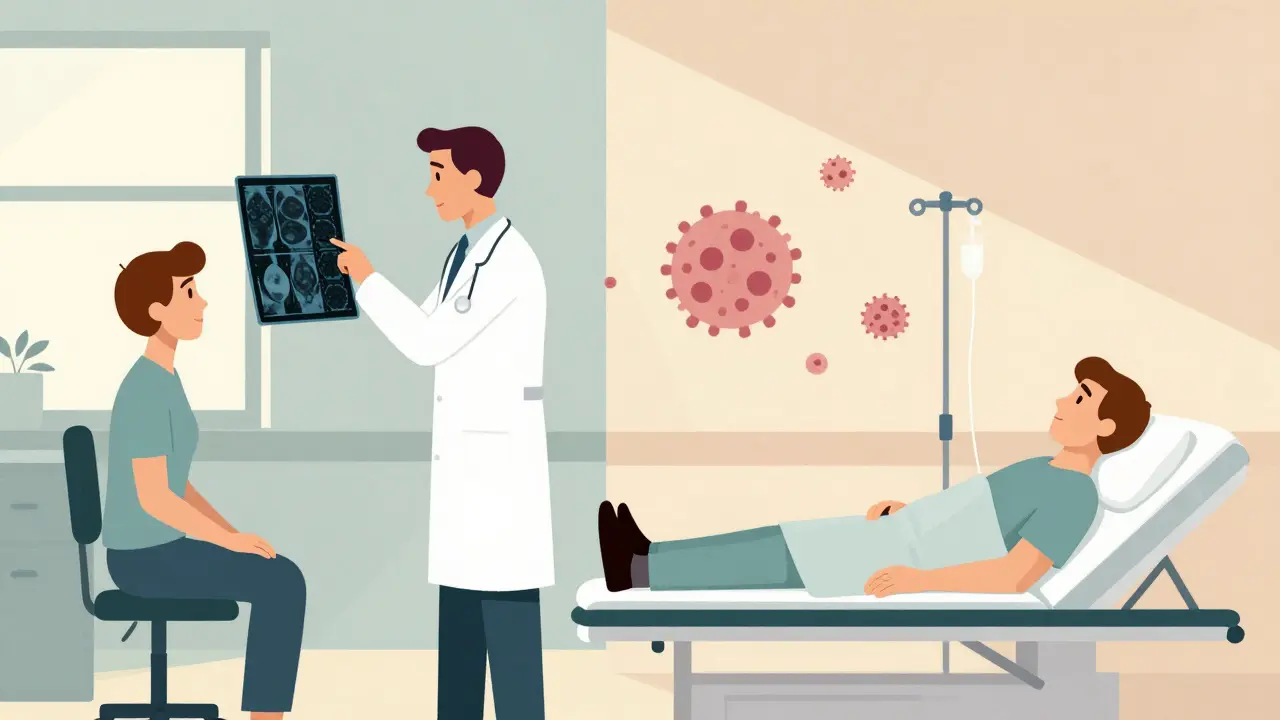
When you’re facing cancer surgery, one of the most important decisions isn’t about the knife-it’s about when to give the drugs. Should you treat before surgery to shrink the tumor? Or wait until after to clean up what’s left? This isn’t just a technical detail. It changes how you feel, how long you recover, and even your chances of survival.
What’s the Difference Between Neoadjuvant and Adjuvant Therapy?
It’s simple: neoadjuvant therapy happens before surgery. Adjuvant therapy happens after. But the impact? That’s anything but simple.
Neoadjuvant means giving chemotherapy, immunotherapy, or radiation before the operation. The goal? Shrink the tumor so it’s easier to remove, kill hidden cancer cells early, and see how your body responds. If the tumor shrinks dramatically, that’s a good sign. If it doesn’t? Your doctors know right away-and can change course before it’s too late.
Adjuvant therapy is the backup plan. After the surgeon removes the tumor, you get treatment to mop up any stray cancer cells that might still be hiding. It’s like cleaning the house after the mess is gone. But here’s the catch: you don’t know if the drugs are working until months later-when you might already be facing a recurrence.
Why Timing Matters More Than You Think
For years, doctors assumed adjuvant therapy was the gold standard. After all, you remove the tumor first, then hit the rest with drugs. But that thinking started to crack in the 2010s.
Take lung cancer. In 2022, the CheckMate 816 trial showed something revolutionary: patients with stage II-III non-small cell lung cancer who got neoadjuvant nivolumab (an immunotherapy drug) plus chemo had a 37% lower risk of their cancer coming back or killing them compared to those who got chemo alone-and then no further treatment after surgery. The pathologic complete response rate? 24%. That means one in four patients had no living cancer cells left in the tumor when it was removed. That’s huge.
In breast cancer, especially triple-negative type, neoadjuvant chemo works even better. About 30-40% of patients achieve a pathologic complete response. And those patients? Their survival rates jump. Studies show they’re more than twice as likely to be alive five years later than those whose tumors didn’t respond.
But here’s the twist: if you give immunotherapy after surgery too, you’re not necessarily adding benefit-you’re adding risk. A major 2024 meta-analysis of over 3,200 patients found that adding adjuvant immunotherapy after neoadjuvant treatment didn’t improve survival. But it did increase serious side effects-from 17.6% to nearly 30%. That’s a lot of nausea, fatigue, and immune-related damage for zero extra benefit.
Who Gets Which Approach?
Not everyone is a candidate. It depends on cancer type, stage, and biology.
For non-small cell lung cancer (NSCLC): If you’re diagnosed with stage IB (tumor ≥4 cm) to IIIA, neoadjuvant chemo-immunotherapy is now standard. The FDA approved this combo in 2022 after CheckMate 816. The key? Your tumor must express PD-L1 (at least 1%). If it doesn’t, chemo alone might still be used-but immunotherapy won’t help.
For breast cancer: Neoadjuvant therapy is recommended for triple-negative, HER2-positive, or large hormone-receptor-positive tumors. It’s not just about shrinking the tumor-it’s about testing how aggressive the cancer is. If you get a complete response, you might avoid more toxic treatments later. If you don’t? Your oncologist can switch to stronger drugs before surgery even happens.
For other cancers: Rectal cancer often gets neoadjuvant chemo-radiation to shrink tumors and avoid permanent colostomies. Melanoma patients with large lymph node involvement are increasingly getting neoadjuvant immunotherapy too.
Adjuvant therapy still has its place. If your tumor is small and low-risk, you might skip neoadjuvant treatment entirely. Or if your cancer responds poorly to pre-surgery drugs, your doctor might recommend extra treatment after surgery-like targeted therapy for EGFR-mutant lung cancer or extended hormone therapy for breast cancer.

The Hidden Advantage: Seeing the Response
One of the biggest reasons neoadjuvant therapy is gaining ground isn’t just survival-it’s information.
Imagine you’re given a new drug. You take it for 12 weeks. Then you get surgery. When the pathologist looks at the tumor under the microscope, they see 95% of the cancer cells are dead. That’s not just a good sign-it’s a roadmap. You now know that drug worked. You can stop there, or use it again if the cancer comes back.
With adjuvant therapy, you’re flying blind. You give the drugs after surgery, hope they work, and wait months to find out if they did. If the cancer returns, you don’t know whether the drugs failed-or if they never had a chance.
This is why some oncologists call neoadjuvant therapy the “real-time test” for cancer treatment. It turns treatment from a guess into a data-driven decision.
What About Side Effects and Delays?
Neoadjuvant therapy isn’t perfect. It can delay surgery. About 10-15% of patients need to postpone their operation because of side effects-low white blood cell counts, severe fatigue, or immune-related inflammation. In rare cases, the cancer grows during treatment. That happens in 5-10% of lung cancer cases.
Patients often feel anxious waiting. One lung cancer patient on a survivor forum said: “I was terrified the tumor would spread while I waited for surgery.” That’s real. But the same patient also said: “When they showed me the scan after chemo and immunotherapy-my tumor was half the size. That gave me hope I didn’t have before.”
Adjuvant therapy comes with its own stress. You’ve just had surgery. You’re healing. Then you’re hit with more chemo, more side effects, more time off work. And you’re still wondering: did it work?
What’s Changing Right Now?
The field is moving fast. In 2021, only 42% of community oncologists offered neoadjuvant immunotherapy for lung cancer. By 2023, that jumped to 78%. Why? Because the data is too strong to ignore.
Trials like KEYNOTE-671 (pembrolizumab), AEGEAN (durvalumab), and NADIM II are confirming the trend. The next big question: Do we even need adjuvant immunotherapy at all?
Early results from the JAMA Network Open meta-analysis suggest no. “The continuation of immunotherapy after surgery may be unnecessary,” the authors wrote. That’s shaking up guidelines. Some experts now say: give the drugs before surgery. Stop. Monitor. Only restart if the cancer comes back.
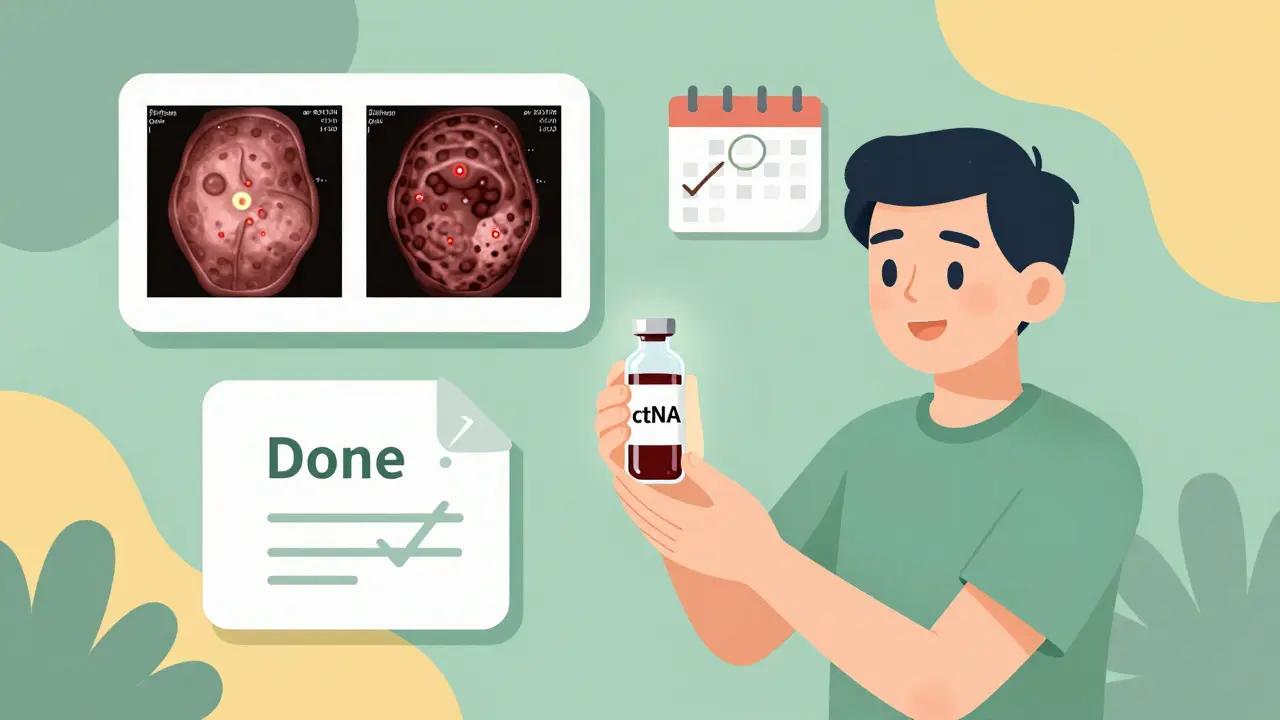
And then there’s ctDNA-circulating tumor DNA. Blood tests that can detect cancer fragments in your bloodstream. Right now, these tests are mostly used in research. But soon, they’ll help decide who needs more treatment after surgery. If ctDNA is gone after neoadjuvant therapy? You might not need adjuvant at all. If it’s still there? You get a stronger, targeted boost.
How Do You Decide?
If you’re facing surgery, ask these questions:
- What’s the stage and type of my cancer?
- Has my tumor been tested for PD-L1, HER2, or EGFR?
- Is neoadjuvant therapy an option for me?
- What’s the chance I’ll get a pathologic complete response?
- What are the side effects of each approach?
- Will I get a biopsy after treatment to see how the tumor responded?
Don’t be afraid to ask for a second opinion. This isn’t a one-size-fits-all decision. What works for a 55-year-old with triple-negative breast cancer might not be right for a 70-year-old with early-stage lung cancer.
The goal isn’t just to survive. It’s to live well after. And sometimes, the best way to do that is to treat early, learn fast, and stop when you don’t need more.
What’s Next for Cancer Treatment?
By 2030, experts predict optimized sequencing could boost 5-year survival for early-stage lung cancer from 60-68% to 75-80%. That’s 15,000-20,000 more lives saved every year in the U.S. alone.
Neoadjuvant therapy isn’t just the future-it’s the present. And for many patients, it’s already the best choice.
Is neoadjuvant therapy better than adjuvant therapy?
For many cancers-like stage II-III non-small cell lung cancer and triple-negative breast cancer-neoadjuvant therapy is now preferred. It gives doctors a chance to see if the treatment works before surgery, improves survival rates, and can shrink tumors enough to make surgery easier. Studies show it doesn’t hurt survival compared to adjuvant therapy, but it often reduces long-term side effects by avoiding unnecessary post-surgery drugs.
Can I skip chemotherapy if I get immunotherapy first?
Not yet. For now, immunotherapy is almost always combined with chemotherapy in the neoadjuvant setting for lung and breast cancer. The combo works better than either alone. But research is ongoing. Trials are testing immunotherapy alone in patients with very high PD-L1 levels, and early results look promising. That could change in the next few years.
What if my tumor doesn’t shrink during neoadjuvant therapy?
That’s actually valuable information. If the tumor doesn’t respond, your oncologist can switch to a different drug combo before surgery-even if you’re already on the schedule. You might get a new regimen for 2-4 more weeks, or your surgeon might adjust the plan. This real-time feedback is something adjuvant therapy can’t offer.
How long after neoadjuvant therapy do I have surgery?
Typically, surgery happens 3 to 6 weeks after the last dose of neoadjuvant treatment. This gives your body time to recover from side effects like low blood counts or fatigue. Waiting too long (more than 12 weeks) can increase the risk of cancer progression. The NADIM II trial showed 3-6 weeks is the sweet spot for safety and effectiveness.
Does neoadjuvant therapy mean I won’t need more treatment after surgery?
Not always. If you have a pathologic complete response (no cancer left in the tumor), you might not need more treatment. But if cancer cells remain, your doctor may recommend additional therapy-like targeted drugs, more chemo, or radiation. The decision depends on your cancer type, stage, and how well the tumor responded.
Are there risks to starting treatment before surgery?
Yes. About 10-15% of patients experience side effects severe enough to delay surgery. In rare cases, cancer can grow during treatment, especially if it’s resistant to the drugs. But the risk of progression is low-around 5-10% in lung cancer-and is often outweighed by the benefits of early treatment and response monitoring.
Choosing between neoadjuvant and adjuvant therapy isn’t about picking the “stronger” option. It’s about picking the smartest one. The one that gives you the most information, the fewest side effects, and the best shot at staying cancer-free.


Write a comment