
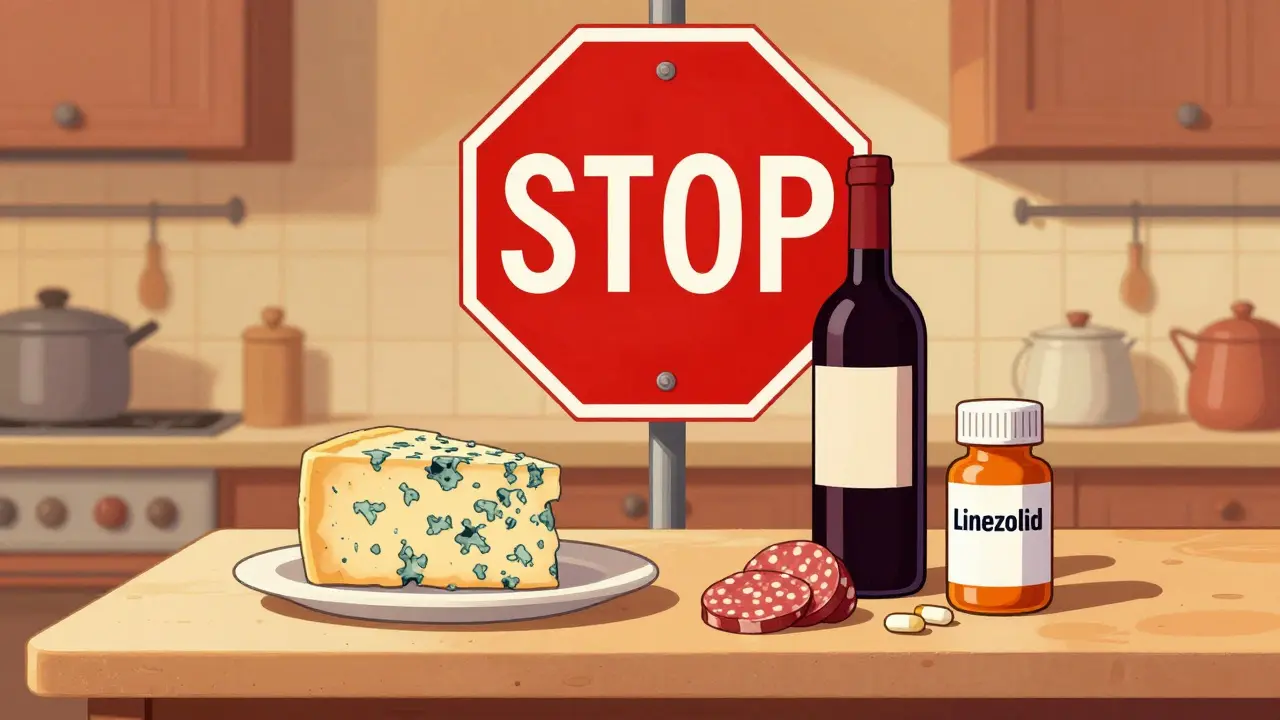
Linezolid Tyramine Calculator
Calculate Your Tyramine Intake
The FDA warns that consuming more than 100 mg of tyramine while on linezolid can cause a dangerous hypertensive crisis. This tool helps you monitor your daily intake from food.
Total Tyramine
0 mgImportant Safety Note
Remember: Even if your total is below 100 mg, consuming high-tyramine foods can still be risky when combined with other factors. Always wait 14 days after your last dose before eating high-tyramine foods. If you experience a headache, chest pain, or blurred vision after eating, call 911 immediately.
Common Food Tyramine Content
When you're prescribed linezolid for a stubborn bacterial infection-like MRSA or VRE-you’re probably focused on getting better. But there’s one thing no one tells you until it’s too late: linezolid can turn your favorite foods into a silent danger. A single bite of aged cheese, a glass of red wine, or even a slice of salami could send your blood pressure soaring-fast. This isn’t a myth. It’s a real, documented risk that’s killed people. And if you’re taking linezolid, you need to know exactly what to avoid, when to avoid it, and why most hospitals don’t even bother with strict diets anymore.
Why Linezolid Is Different from Other Antibiotics
Linezolid, sold under the brand name Zyvox, is a powerful antibiotic used when other drugs fail. It works against tough Gram-positive bacteria that have become resistant to vancomycin or methicillin. But here’s the catch: linezolid also acts as a weak monoamine oxidase inhibitor (MAOI). That’s the same class of drug once used to treat depression, like phenelzine or tranylcypromine. And like those older antidepressants, linezolid blocks the enzyme that breaks down tyramine-a naturally occurring compound in aged, fermented, or spoiled foods.When tyramine builds up in your body because your body can’t break it down, it triggers a massive release of norepinephrine. That’s a powerful chemical that tightens your blood vessels. The result? A sudden, dangerous spike in blood pressure-sometimes 30 to 50 mmHg higher than normal. That’s not just a headache. That’s a hypertensive crisis: risk of stroke, heart attack, or even death.
The FDA says this can happen when you consume more than 100 mg of tyramine while on linezolid. Sounds like a lot? It’s not. A single slice of blue cheese can have over 100 mg. A 12-ounce bottle of tap beer? Up to 70 mg. A serving of salami? Around 150 mg. You don’t need to eat a whole plate of dangerous foods. One wrong bite is enough.
What Foods Are Actually Dangerous?
Not all old or fermented foods are created equal. Some are high-risk. Others? Mostly safe. The key is knowing which ones carry the most tyramine.- Avoid completely: Aged cheeses (Parmesan, blue cheese, cheddar, Swiss), dry fermented sausages (pepperoni, salami, chorizo), tap beer, bottled or canned beer, ale, stout, port, vermouth, liqueurs, homemade wine, champagne, and soy sauce (especially dark or fermented).
- Use extreme caution: Chocolate (more than 1 ounce), yeast extracts (like Marmite), overripe fruits, and pickled herring. Even though these have less tyramine, sensitivity varies.
- Safe to eat: Fresh meat, poultry, and fish (never smoked, cured, or aged); fresh fruits and vegetables; pasteurized milk and dairy; bread, pasta, rice; decaffeinated coffee and tea; and small amounts of white wine (one 5-ounce glass).
Here’s the truth most doctors don’t say: if you’re in the hospital, you’re probably fine. Standard hospital meals are designed to be low in tyramine. A 2010 study from NewYork-Presbyterian found that even the highest-tyramine hospital meal contained less than 42 mg total-well below the 100 mg danger zone. That’s why most U.S. hospitals stopped enforcing strict diets for inpatients by 2015. The real danger is for people taking linezolid at home.
Why Outpatients Are at Higher Risk
If you’re on linezolid as an outpatient, you’re eating your own food. That means you’re in control of what’s on your plate-and that’s where things go wrong.A 2019 survey in the Journal of Antimicrobial Chemotherapy found only 45% of patients received proper dietary counseling before leaving the hospital. That means more than half were sent home with a dangerous antibiotic and no idea what to avoid. One Drugs.com user reported a 45 mmHg blood pressure spike after eating blue cheese on day 3 of treatment. Another told his pharmacist he didn’t think cheese was a big deal-until he ended up in the ER.
And it’s not just cheese. Craft beers are a hidden trap. Many people think “light beer” or “IPA” is safe. But any beer that’s unpasteurized, bottle-conditioned, or fermented in bulk contains tyramine. Even some kombucha and kefir can be risky. And don’t assume “organic” or “artisanal” means safer-it often means more fermentation, more tyramine.
Game meats, liver, and pâté are also dangerous. These are often improperly stored or aged, even if they look fresh. The bacteria that break down proteins in meat create tyramine over time. If it’s not eaten the day it’s butchered, it’s a risk.

The 14-Day Rule: Why You Can’t Just Stop the Drug and Eat Normally
You might think: “I finished my 10-day course of linezolid. I’m good to go.” Wrong.Linezolid leaves your system in about 5 hours. But its effect on monoamine oxidase doesn’t. The enzyme stays blocked for days after the last dose. That’s why experts-including Dr. Brian Staiger, PharmD, in his January 2025 update-say you must wait at least 14 days after your last pill before eating any high-tyramine food.
Why 14 days? Because your body needs that long to make new monoamine oxidase enzymes. If you jump the gun, you’re still vulnerable. And here’s the scary part: 78% of reported adverse events happen after patients resume their old diets too soon. Not during treatment. After.
There’s no test to tell you when your enzymes are back to normal. No blood test. No home kit. So you wait. Two weeks. No shortcuts.
What About Chocolate, Coffee, and Wine?
Chocolate is tricky. Dark chocolate has more tyramine than milk chocolate. A small piece (under an ounce) is usually fine. But if you’re snacking on a whole bar, you’re flirting with danger. Same with coffee: decaf is safe. Regular coffee? The caffeine isn’t the issue-it’s the fermentation in the beans. One cup is low-risk, but three? Maybe not.Wine is a minefield. White wine? One small glass (5 oz) is acceptable. Red wine? Absolutely not. Even a sip of Chianti or Cabernet can trigger a crisis. The same goes for fortified wines like sherry and port. Champagne and sparkling wines? Avoid. They’re often fermented with yeast that produces tyramine.
And yes-soy sauce. Even a tablespoon in your stir-fry can add 20-30 mg of tyramine. If you’re eating teriyaki, miso soup, or fermented tofu, you’re at risk. Look for low-sodium or non-fermented alternatives.
What If You Accidentally Eat Something Risky?
If you eat a high-tyramine food and start feeling a pounding headache, blurred vision, chest pain, nausea, or a sudden spike in blood pressure-stop. Don’t wait. Call 911 or go to the nearest ER.There’s no antidote. Treatment is supportive: lowering blood pressure with fast-acting drugs, monitoring heart function, and waiting it out. The sooner you get help, the better your outcome. But prevention is far easier than treatment.
Keep a blood pressure monitor at home if you’re on linezolid. Check it daily. If your systolic (top number) jumps more than 20 mmHg above your normal baseline, it’s a red flag-even if you feel fine.

What Hospitals Got Right (and What They Got Wrong)
Before 2010, hospitals treated linezolid like it was a psychiatric MAOI. Patients got bland, tasteless meals. No cheese. No meat. No flavor. It was exhausting-for patients and staff.Then came the 2010 study by Rumore and her team. They looked at real hospital menus. They tested actual meals. And they found: most hospital food was safe. So they changed the rules. Today, 95% of U.S. hospitals follow evidence-based guidelines: no blanket restrictions. Just avoid the big offenders: aged cheese, fermented meats, and draft beer.
This saved hospitals $18 million a year in food costs. But more importantly, it reduced patient stress. You don’t need to live on boiled chicken and rice. You just need to avoid the top 5 high-risk items.
Who Should Be Talking to You About This?
Your doctor might not know the details. Your pharmacist? They should. But too often, the responsibility falls on you.Ask your pharmacist: “What specific foods should I avoid with linezolid?” Don’t accept vague answers like “avoid aged foods.” Demand specifics: Which cheeses? Which beers? How much chocolate is safe?
Ask for the NHS MAOI Diet Sheet. It’s the gold standard. It’s clear, practical, and based on real food testing-not guesswork. You can find it online (search “NHS MAOI Diet Sheet”) and print it. Keep it on your fridge.
If you’re eating out, tell the server: “I’m on an antibiotic that interacts with tyramine. Can you confirm this dish doesn’t have aged cheese, soy sauce, or fermented meats?” Most restaurants are happy to accommodate. Better safe than sorry.
The Bigger Picture: Why This Matters
Linezolid is a last-resort antibiotic. It’s expensive. It’s powerful. And it’s one of the few tools we have against superbugs like MRSA. If we misuse it-by letting patients get sick from dietary mistakes-we risk losing its effectiveness faster.But here’s the truth: the dietary restrictions aren’t about being perfect. They’re about being smart. You don’t need to give up all joy in eating. You just need to know which foods are landmines.
Linezolid saves lives. But it can also take them-if you’re not careful. The good news? You don’t need to live like a monk. Just avoid the big five: aged cheese, fermented meats, tap beer, red wine, and soy sauce. Wait two weeks after your last pill. And if you feel something’s wrong-don’t wait. Act.
This isn’t about fear. It’s about awareness. And awareness saves lives.
Can I drink coffee while taking linezolid?
Yes, but stick to decaffeinated coffee. Regular coffee has low tyramine, but the caffeine can worsen blood pressure spikes. One cup is usually safe, but avoid multiple cups a day. Decaf is the safer choice.
Is it safe to eat cheese if it’s refrigerated and fresh?
Only if it’s truly fresh-like mozzarella or ricotta made that day. Any cheese that’s aged, ripened, or stored for more than a few days can develop tyramine. Blue cheese, cheddar, Swiss, and Parmesan are high-risk even if refrigerated. Stick to fresh, unaged dairy.
How long after stopping linezolid can I drink alcohol?
Wait at least 14 days after your last dose. Even light beer, wine, or cider can contain tyramine. Red wine, craft beer, and fortified wines are especially dangerous. If you’re unsure, avoid alcohol entirely until the 14-day window is over.
Can I take over-the-counter cold medicine with linezolid?
No. Many cold and flu medicines contain pseudoephedrine, phenylephrine, or dextromethorphan-all of which can interact dangerously with linezolid. Always check with your pharmacist before taking any OTC drug. Use acetaminophen for pain or fever instead.
What should I do if I miss a dose of linezolid?
Take it as soon as you remember, unless it’s close to your next dose. Never double up. Missing doses doesn’t reduce your MAOI risk-you’re still protected for days after the last pill. Keep following dietary restrictions until 14 days after your last dose, no matter what.
Are there any alternatives to linezolid that don’t require a special diet?
Yes, but only if your infection allows it. For MRSA, alternatives include daptomycin, vancomycin, or ceftaroline. For VRE, options include dalbavancin or oritavancin. But these aren’t always available or effective. Linezolid is often the only choice. Don’t refuse it because of the diet-just follow the rules strictly.
Can I eat soy products like tofu or tempeh?
Plain, fresh tofu is low in tyramine and safe. Tempeh is fermented and should be avoided. Soy sauce, miso, and fermented soy pastes are high-risk. Stick to fresh, non-fermented soy products and avoid anything labeled “fermented” or “aged.”
Does linezolid affect blood pressure even if I don’t eat tyramine?
Linezolid can cause low blood pressure (hypotension) as a side effect in some people, especially with long-term use. But the dangerous high blood pressure spike only happens with tyramine intake. So if you avoid tyramine-rich foods, your blood pressure should stay stable.


Write a comment