
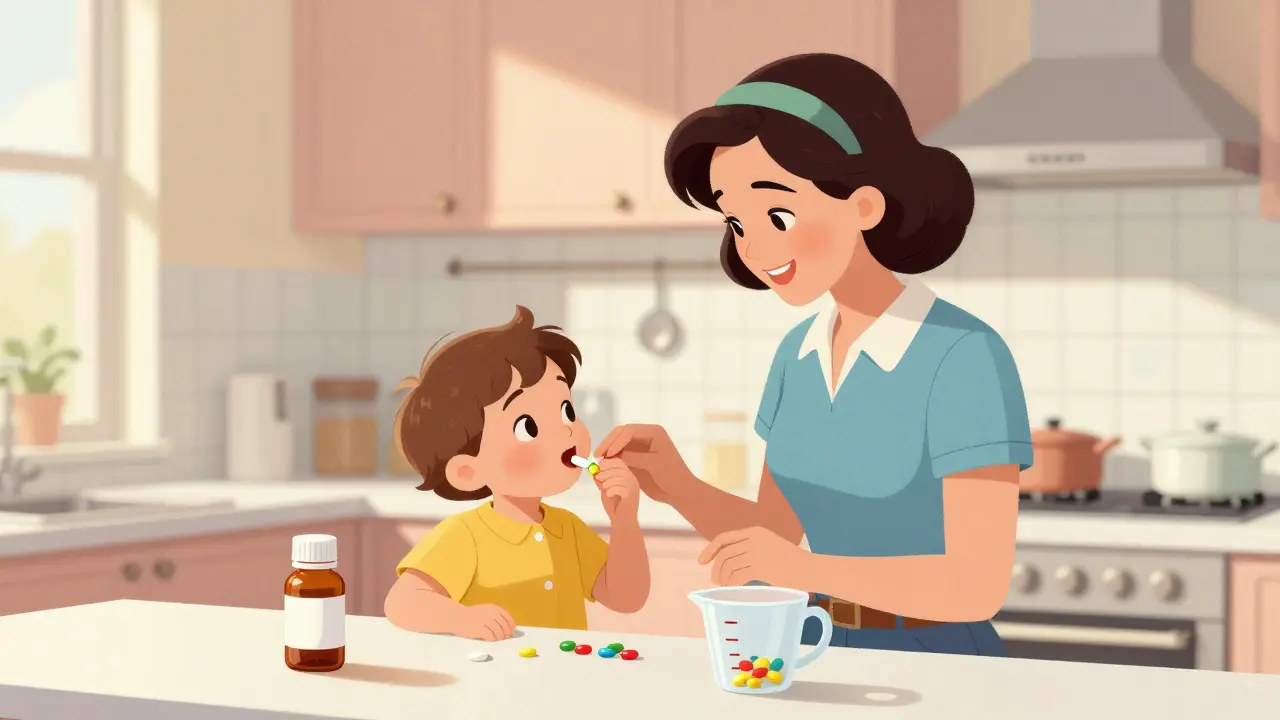
Switching your child from liquid medicine to a chewable or tablet can seem like a simple change-no more measuring cups, no more spills, no more refrigeration. But if done wrong, it can mean the difference between your child getting the full dose they need and the medicine not working at all. Many parents make this switch hoping for convenience, but without the right steps, they accidentally reduce effectiveness-or worse, cause harm.
Why Switch from Liquid to Chewable or Tablet?
Liquid medications are common for kids because they’re easy to swallow and doses can be adjusted by volume. But they come with big downsides. A 2022 study by the American Association of Pharmaceutical Scientists found that parents make dosing errors up to 20% of the time with liquid meds-using kitchen spoons, misreading labels, or forgetting to shake the bottle. That’s not just inconvenient; it’s dangerous. Chewable tablets fix those problems. They come in fixed doses, so you don’t need to guess how much to give. They’re also more stable. Most liquid medicines last 12 to 18 months, but chewables can last up to 3 years without refrigeration. That’s a huge help when you’re traveling, at daycare, or just tired of hauling around a bulky bottle. And compliance? It’s better. Studies show 40-60% of kids don’t take their liquid meds correctly-because they taste bad, they’re messy, or the child refuses. Chewables? Many kids actually like them. Brands like Tylenol Chewables and Advil Children’s Chewables are designed to taste like fruit candy, not medicine.Not All Chewables Are the Same
Just because it’s called a “chewable” doesn’t mean your child can just swallow it whole. There are five types, and only one of them is safe to swallow without chewing:- MUST be chewed (like Tums or some antacids)-swallowing whole means it won’t dissolve fast enough.
- MUST be chewed or crushed (like some antibiotics)-if swallowed, the drug may not get absorbed.
- Can be chewed or dispersed in water (some ODTs)-these are more forgiving.
- Can be chewed or swallowed whole (some antihistamines)-these are formulated to dissolve even if not chewed.
- No specific instructions-about 30% of chewables fall into this risky category. If the label doesn’t say, assume it must be chewed.
Here’s the danger: a 2023 University of Toledo study found that 12.7% of kids who switched from liquid potassium chloride to chewables had treatment failure-because they swallowed the tablet whole. The tablet took over two hours to dissolve instead of the 30 minutes it should’ve taken. That’s a delay that can turn a mild infection into a serious one.
Check Bioequivalence First
You can’t just swap a liquid for a chewable and assume it’s the same. The drug must be released the same way in the body. That’s called bioequivalence. The FDA requires that chewable versions deliver the same amount of medicine into the bloodstream as the liquid version-within 80-125% of the original. This isn’t just a formality. For example, switching from liquid amoxicillin to chewable amoxicillin requires proof that the body absorbs the same amount. If it doesn’t, your child might get too little (and the infection won’t clear) or too much (and risk side effects). Always check the FDA Orange Book to confirm the chewable version is approved as bioequivalent to the liquid. If you’re unsure, ask your pharmacist. They can pull up the data. Never assume two versions of the same drug are interchangeable.Dosage Isn’t Always 1:1
This is where most mistakes happen. Parents think: “My child was getting 5 mL of liquid, so one chewable must be the same.” Not always. Take Tylenol Children’s Suspension: it’s 160 mg per 5 mL. The chewable tablet is also 160 mg. So one tablet equals one dose. Easy. But now consider a child who weighs 15 pounds. The liquid dose is 80 mg, which is half a teaspoon. The chewable tablet is still 160 mg. So you can’t give half a tablet. You’d need to find a 80 mg chewable-or split a 160 mg tablet (if it’s scored). The American Society of Health-System Pharmacists found that 87% of dosing errors in pediatric transitions came from misreading weight-based conversions. Always double-check the exact dose your child needs based on their weight, not just the volume they were getting before.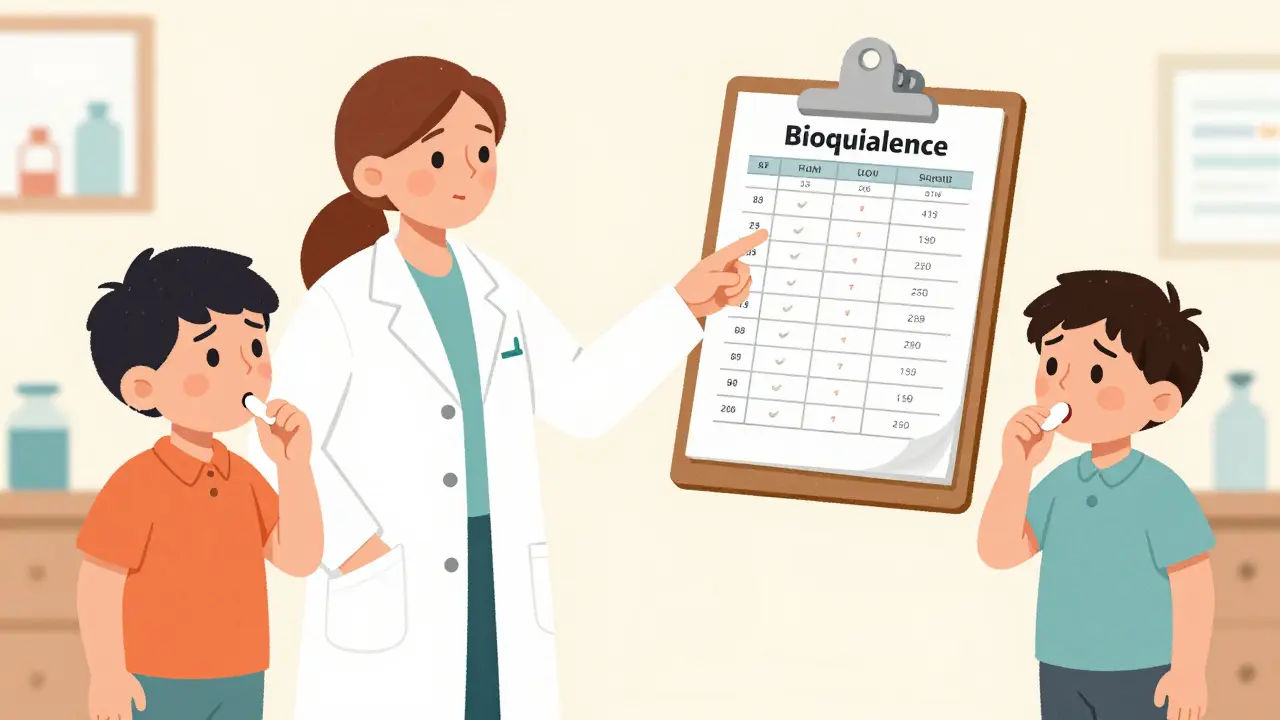
Teach Proper Chewing Technique
Even if the tablet is right and the dose is correct, your child might still fail to get the full benefit-if they don’t chew properly. A 2023 study at University College London found that 23% of transition failures happened because kids swallowed the tablet whole or chewed it too quickly. For the medicine to work, the tablet needs to be chewed for at least 15-20 seconds. That breaks it down into small particles (100-300 microns) so it dissolves quickly in the stomach. Try this: Before giving the tablet, show your child how to chew it like gum. Say, “Chew it like candy-until it’s all gone.” For younger kids, make it a game: “Let’s chew 10 times before you swallow.” And never let them chase it with a big gulp of water right away. Let the chewed bits sit in the mouth and mix with saliva for a few seconds before swallowing. That helps the medicine start dissolving faster.Watch for Size and Taste
Some chewables are too big. A 500 mg tablet might be the right dose, but if it’s the size of a quarter, a 4-year-old might gag or refuse. That’s why many newer chewables are made in smaller, softer forms. Taste matters too. A 2023 review on Drugs.com showed that 22% of negative experiences with chewables were because the taste wasn’t as good as the liquid. Some kids will spit out a tablet that tastes medicinal-even if it’s the same drug. If your child refuses a chewable, ask your pharmacist if there’s another brand. Some use different flavorings or sweeteners. Or, if the tablet is scored, ask if it can be crushed and mixed with a little applesauce or yogurt (only if the label allows it).Know When NOT to Switch
Not every child is ready for chewables. If your child has:- A history of choking or swallowing problems
- Diagnosed dysphagia (difficulty swallowing)
- Developmental delays affecting chewing
- Severe asthma or allergies that make chewing risky
then stick with liquid-or ask about orally disintegrating tablets (ODTs). These dissolve on the tongue in seconds without chewing. They’re a great middle ground.
Also, avoid switching high-dose meds (over 500 mg) to chewables. The tablets get too large and hard to manage. For those, liquid or ODTs are still the best choice.

Follow a 5-Step Transition Plan
The University of Toledo Medical Center has a proven protocol for switching medications safely. Use this checklist:- Confirm bioequivalence-Check the FDA Orange Book or ask your pharmacist.
- Assess swallowing ability-Can your child chew and swallow solid food without choking? If unsure, ask your pediatrician to do a quick screening.
- Calculate the exact dose-Don’t guess. Use your child’s weight and the drug’s dosing chart. Use the ISMP Medication Safety Calculator if you need help.
- Teach chewing technique-Show them how to chew for 15-20 seconds. Practice with a piece of candy first.
- Follow up within 72 hours-Call your pharmacist or doctor. Ask: “Is the medicine working? Any vomiting, refusal, or side effects?”
What’s New in Chewable Medications?
Technology is making chewables smarter. In May 2023, the FDA approved the first “intelligent” chewable tablet-ChewSmart™. It changes color when chewed long enough. If it’s still white, the child didn’t chew enough. If it turns blue, they did. A University of Michigan study showed this boosted adherence from 65% to 92%. 3D-printed chewables are also in trials. These let pharmacists print a tablet with the exact dose your child needs-down to the milligram-without needing multiple sizes. That’s huge for kids who need custom doses.Real Stories, Real Results
One mom in Vancouver switched her 5-year-old from liquid trimethoprim-sulfamethoxazole to chewables after three UTIs in six months. The liquid was messy, spilled, and the child refused it. After switching, adherence jumped from 65% to 92% over six months. No more infections. Another parent, whose 8-year-old had asthma, switched from liquid albuterol to chewables without proper instruction. The child swallowed the tablet whole. The medicine didn’t work. The child had an asthma attack and ended up in the ER. After education on chewing, the problem stopped.Final Checklist: Before You Switch
- ✅ Is the chewable version FDA-approved as bioequivalent to the liquid?
- ✅ Do I know the exact dose based on my child’s weight?
- ✅ Is the tablet size appropriate for my child’s age?
- ✅ Does the label say “must be chewed”?
- ✅ Have I shown my child how to chew it properly?
- ✅ Do I have a plan to follow up in 72 hours?
If you answered yes to all six, you’re ready. If not, pause. Talk to your pharmacist. Don’t risk your child’s health on a guess.
Can I crush a chewable tablet and mix it with food?
Only if the label or your pharmacist says it’s safe. Some chewables are designed to release medicine slowly, and crushing them can make the dose too strong or too fast. Others, like some antihistamines, can be crushed without issue. Always check first.
What if my child refuses to chew the tablet?
Try a different flavor or brand. Some chewables taste more like candy than medicine. If that doesn’t work, ask about orally disintegrating tablets (ODTs)-they dissolve on the tongue without chewing. Or stick with liquid until your child is ready.
Are chewable tablets safe for toddlers under 2?
Generally, no. Most chewables are designed for children 2 and older. Toddlers under 2 often can’t chew safely and are at risk of choking. Stick with liquid or ask your doctor about ODTs or suspensions.
Do chewable tablets have more sugar than liquids?
Yes, many do. Chewables often contain 20-30% more sweeteners to improve taste. If your child has diabetes or is on a low-sugar diet, ask your pharmacist for a sugar-free version. Some brands now offer sugar-free chewables using stevia or xylitol.
How do I store chewable tablets?
Keep them in a cool, dry place-like a medicine cabinet. No refrigeration needed. Avoid bathrooms (too humid) and windowsills (too hot). Always keep them out of reach of young children.
What if my child swallows a chewable tablet whole?
If the tablet is meant to be chewed, swallowing it whole may delay or reduce its effect. Don’t panic-but watch for signs the medicine isn’t working (fever returning, symptoms not improving). Call your pharmacist. If it’s a high-dose or critical medication, contact your doctor. In the future, always check the label for instructions.


Write a comment