
Getting the right dose from an inhaler, patch, or injectable isn’t just about following directions-it’s about understanding what the label is really saying. Unlike pills, these delivery systems don’t let you guess. A tiny mistake-misreading concentration, ignoring heat warnings, or thinking a canister is empty when it’s not-can land you in the ER. In 2023, over 1,400 serious adverse events in the U.S. were tied directly to misreading labels on these devices. Most of them were preventable.
What’s on an Inhaler Label-and What You’re Probably Missing
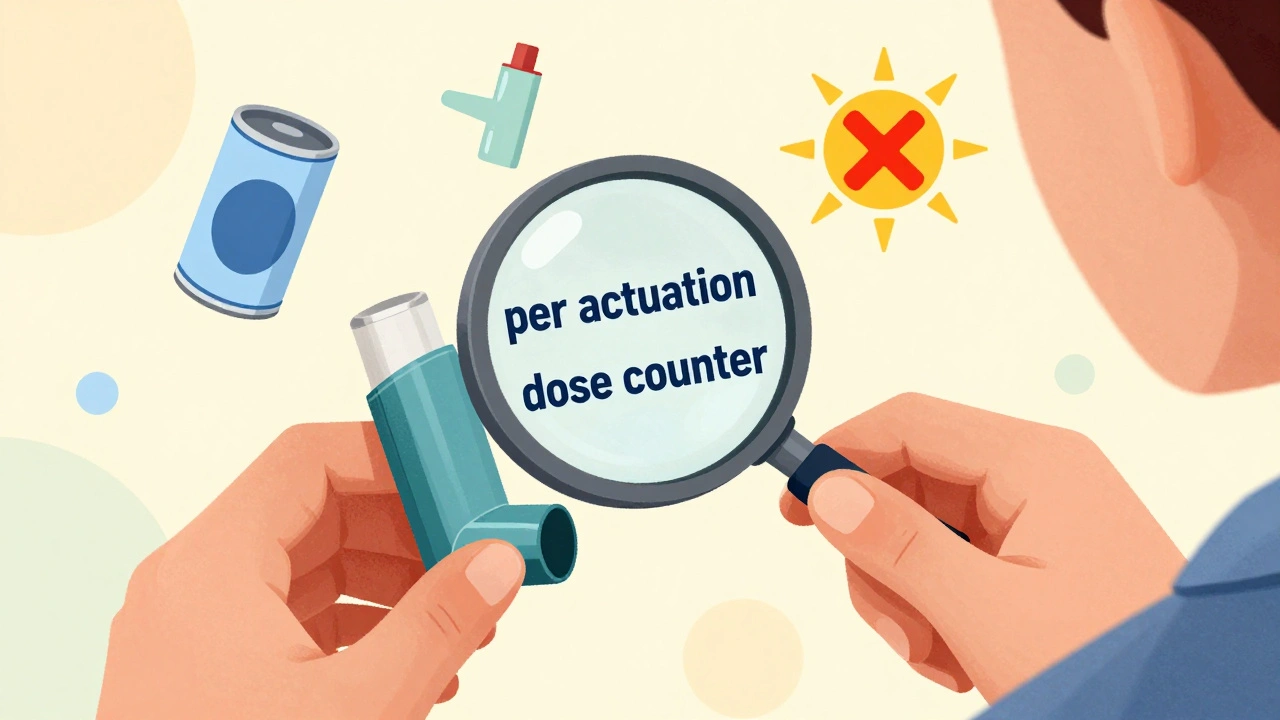
Inhaler labels look simple: drug name, dose, number of puffs. But the details matter. Look for the phrase “per actuation.” That’s the amount of medicine released with each spray. For example: “albuterol sulfate 90 mcg per actuation.” If you think you’re getting 180 mcg because you sprayed twice, you’re right-but only if the label says two puffs are needed. Some inhalers require one puff; others need two. Never assume.Check the dose counter. Since May 2024, all new inhalers sold in the U.S. must have a visible counter showing how many doses remain. Older models without counters are still in use. If yours doesn’t have one, don’t rely on how heavy it feels. The canister can feel full even when it’s empty. A 2023 Cleveland Clinic study found that nearly 28% of patients made dosing errors because they trusted the weight, not the label.
Look for “prime before first use.” That means you need to spray it into the air four times before your first dose. Skip this, and the first few puffs may deliver nothing. Also, check if it says “shake well.” Only suspension inhalers need this. Solution inhalers don’t. Mixing them up can lead to underdosing.
Patch Labels: More Than Just “Change Every 72 Hours”
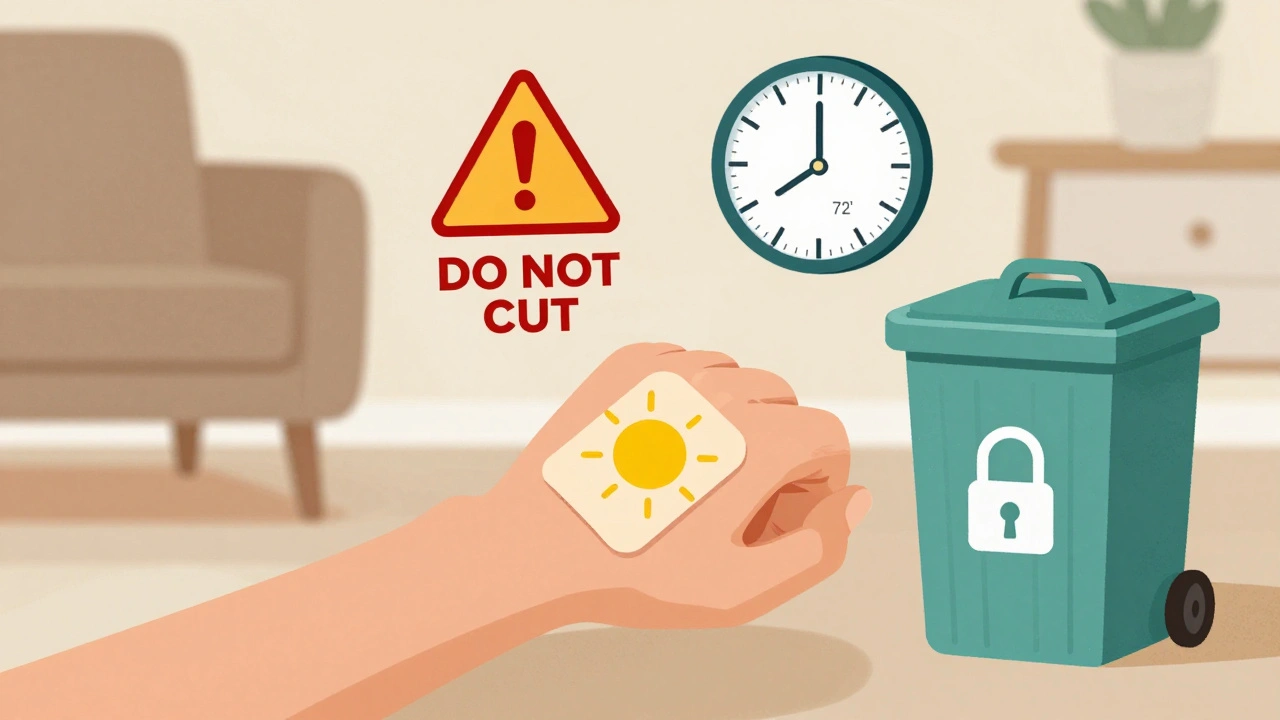
Transdermal patches seem straightforward: stick it on, wait, replace. But the label hides critical warnings. First, look for the delivery rate: “fentanyl 25 mcg/hour.” That’s the amount released every hour. If you think it’s 25 mcg total, you’re off by a factor of 72. That’s how many hours the patch lasts.Pay attention to the application site. Some patches say “apply to clean, dry skin.” Others forbid use on areas with cuts, burns, or rashes. And never apply heat-hot showers, heating pads, or even sitting in the sun can increase absorption by up to 50%. Health Canada issued a safety alert in 2021 after multiple overdose cases linked to heat exposure.
“Change every 72 hours” means exactly 72 hours. Not “about three days.” Not “when it starts to peel.” A 2023 Consumer Reports survey found that 63% of patients didn’t realize this meant precise timing. Delaying replacement can lead to overdose. Removing it? Don’t fold it in half or flush it. Fentanyl patches still contain enough drug to kill a child if improperly disposed of. The label should say “dispose of safely” and often includes a take-back program or return envelope.
Injectables: Concentration Is Everything
Injectables are where mistakes become deadly. The biggest red flag? Concentration. Insulin labels say “U-100,” meaning 100 units per milliliter. But some insulin is U-500-five times stronger. If you draw up 10 units from a U-500 vial thinking it’s U-100, you’ve given yourself 50 units. That’s a medical emergency.Look for “reconstitute before use” on some injectables. These come as powder and need mixing with a liquid. The label will tell you exactly how much liquid to add and how to swirl (not shake) the vial. Shaking can damage the drug. Also, check storage: some need refrigeration before opening; others go in the fridge only after mixing.
Don’t confuse similar-looking vials. A 2023 PatientsLikeMe thread revealed that 57% of visually impaired users struggled to tell apart insulin, octreotide, and other injectables-even with auxiliary labels. Octreotide comes in 200 mcg/mL and 1,000 mcg/mL versions. Mixing them up can lead to underdosing or overdose. Always double-check the number on the vial against your prescription.
Why Pictograms and QR Codes Are Game-Changers
Text alone isn’t enough. Since 2020, 78% of inhaler labels now include pictograms: simple drawings showing how to inhale, hold your breath, or rinse your mouth. A 2023 study in the Journal of the American Pharmacists Association found these reduced technique errors by 37%.QR codes are now on 67% of specialized delivery systems-up from just 12% in 2021. Scan the code with your phone, and you’ll get a short video showing how to use the device. One study showed patient comprehension jumped 29% when these videos were used. If your label has one, use it. It’s not a gimmick-it’s a safety tool.
Look for the “do not cut” warning on patches. Fentanyl patches, for example, are designed to release drug slowly. Cutting them turns them into a fast-acting overdose risk. The FDA found cutting increases overdose risk by 4.7 times. This warning appears on 89% of fentanyl patches today.

What to Do If You’re Still Confused
You’re not alone. A 2023 JAMA Internal Medicine study found only 38% of patients got a full 15- to 20-minute counseling session from their pharmacist when picking up these medications. That’s not enough. Demand it. Ask your pharmacist to walk you through the label. Bring your device. Point to the parts you don’t understand.Write down the key points: dose per use, how often, how long it lasts, what to avoid. Don’t rely on memory. Keep this note in your wallet or phone. If you take multiple devices, label them clearly-“Inhaler: Albuterol,” “Patch: Fentanyl,” “Injectable: Insulin U-100.”
Check for updates. Labels change. New versions come out. If you refill and the label looks different, ask why. A 2023 FDA review found that 14% of patients didn’t notice changes in their inhaler’s dose counter design, leading to accidental overdoses.
Use the FDA’s Medication Guide portal or your pharmacy’s app to access digital versions of your label. Many now include interactive tools that simulate the device and show you how to use it step by step.
Final Checklist: Before You Use Any of These
- Inhaler: Is the dose counter visible? Did I prime it? Is it a suspension or solution? Do I need to shake it?
- Patch: Is the delivery rate clear? Is the site clean and dry? Am I avoiding heat? Do I know when to remove it? How do I dispose of it safely?
- Injectable: Is the concentration labeled? (U-100, U-500, 200 mcg/mL?) Did I mix it correctly? Is it stored properly? Do I have the right syringe?
If any answer is “I’m not sure,” stop. Call your pharmacist. Don’t risk it. These devices are powerful. They’re not like pills. One wrong move can change your health forever.
What should I do if my inhaler doesn’t have a dose counter?
If your inhaler lacks a dose counter, track your usage manually. Count each spray and write down how many you’ve used. Most inhalers hold 120 or 200 doses. Divide that number by how many puffs you take per day. For example, if you use two puffs twice daily (4 per day), a 120-dose inhaler will last 30 days. Mark your calendar for replacement. Never rely on how heavy it feels.
Can I cut a patch to make it last longer or reduce the dose?
Never cut a transdermal patch. Cutting it disrupts the slow-release design and can cause a dangerous spike in drug levels. Fentanyl patches, for example, release medication over 72 hours. Cut one, and you risk delivering the full dose all at once. The FDA has documented multiple overdose deaths from this practice. If you need a lower dose, ask your doctor for a different patch strength.
Why does my insulin label say U-100 and not 100 units?
The “U” stands for “units.” U-100 means 100 units per milliliter. This is the standard concentration in the U.S. But some insulin types, like U-500, are five times stronger. If you use a U-100 syringe with U-500 insulin, you’ll give five times the dose you intend. Always check the “U” number on the vial and match it to your syringe. Never assume-always confirm.
What if I accidentally apply a patch to my face or eyes?
Remove the patch immediately. Wash the area gently with cool water-don’t scrub. Call your doctor or poison control. Some patches, especially fentanyl or nicotine, can cause rapid absorption through mucous membranes. Symptoms like dizziness, rapid heartbeat, or nausea can appear within minutes. Don’t wait. Even small amounts absorbed through the eyes or mouth can be dangerous.
How do I know if my injectable medication is still good?
Check the expiration date on the vial or pen. Then look at the liquid. If it’s cloudy when it should be clear (like insulin), discolored, or has particles, don’t use it. Some injectables, like growth hormones, must be refrigerated after mixing. If left unrefrigerated for more than a few hours, they can break down. When in doubt, throw it out and get a new one. Medication safety is better than cost savings.


Write a comment