
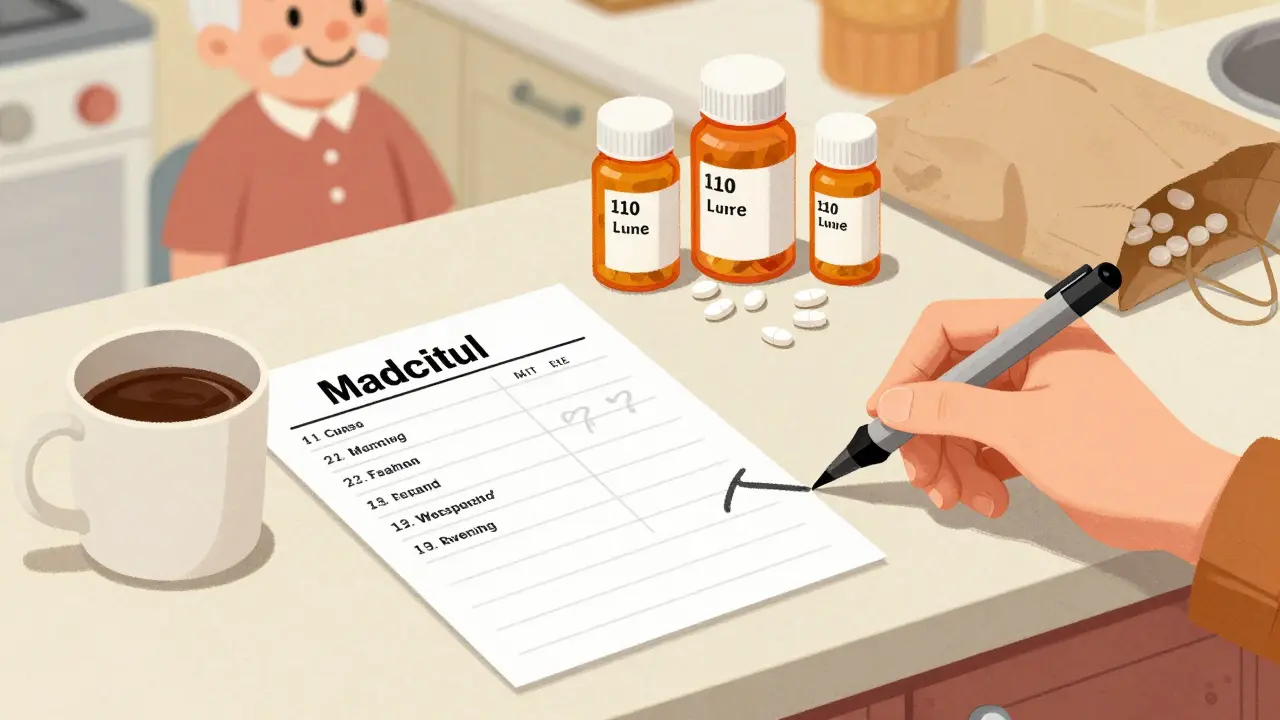
Why a Medication List Matters More Than You Think
Imagine this: your parent is rushed to the ER after feeling dizzy. The doctors ask what medications they’re taking. You try to remember - but you’re not sure if they took their blood pressure pill this morning, or if the new painkiller the doctor prescribed last week is still being used. You pull out a crumpled napkin with scribbles. That’s not enough. In fact, it’s dangerous.
Over 40% of seniors take five or more medications. That’s called polypharmacy. And it’s not just common - it’s risky. Taking too many drugs without a clear system increases the chance of bad reactions by 88%. Every year, about 7,000 people in the U.S. die from medication errors. Most of those happen at home, not in hospitals. The fix isn’t high-tech. It’s simple: a clear, updated, easy-to-read medication list.
This isn’t just for doctors. It’s for you - the caregiver. It’s for family members who show up to help. It’s for pharmacists who refill prescriptions. And if something goes wrong, it could save a life.
What to Include on the List (The 12 Essentials)
A good medication list isn’t just a note. It’s a legal and medical tool. The FDA and AHRQ agree: it needs 12 key details for every drug. Don’t skip any.
- Medication name - Write both brand and generic. Example: Lisinopril (Zestril)
- Dosage - Be exact. Not “one pill.” Say “Lisinopril 10 mg.”
- Frequency - “Twice daily,” “every 8 hours,” “as needed.” Don’t say “morning and night” - specify times like 8 a.m. and 8 p.m.
- Purpose - Why are they taking it? “For high blood pressure,” “for arthritis pain,” “for sleep.”
- Special instructions - “Take with food,” “don’t crush,” “avoid grapefruit,” “shake well.”
- Start date - When did they begin this drug?
- Prescribing doctor - Name and clinic or hospital.
- Pharmacy name and phone - Where it’s filled. Keep this updated.
- National Drug Code (NDC) - Found on the bottle. Helps pharmacists avoid mix-ups.
- Stop date - For time-limited prescriptions. If it says “take for 14 days,” write when it ends.
- Side effects to watch for - Dizziness? Swelling? Confusion? List them so you know when to call the doctor.
- Allergies - Not just drugs. Include food or latex if relevant. This alone prevents over 1 million bad reactions a year.
Don’t forget supplements. People think “natural” means safe. But fish oil can thin blood. Vitamin K messes with warfarin. Turmeric affects blood sugar. Treat every pill, capsule, or gummy like a prescription.
Choose Your Format: Paper, Digital, or Both
There’s no single right way. But there is a best way - and it’s a combo.
Paper lists are still used by 63% of caregivers. They’re reliable. No battery. No app crash. Keep one in a wallet, taped to the fridge, and in a binder with medical records. Use a laminated sheet so you can write and wipe it clean. Many caregivers swear by the “brown bag method”: bring all pills in a bag to every appointment. Doctors love it.
Digital tools like Medisafe, MyMeds, or even a shared Google Doc can be powerful. They send reminders. They update automatically when pharmacies refill. CVS and Walgreens now sync prescriptions to their apps. But here’s the catch: 62% of caregivers over 65 find apps too hard to use. And 71% of family caregivers quit using apps within three months because they’re too complicated or time-consuming.
So here’s what works: One master paper list, updated daily, and one digital backup. Use the paper list as your go-to during emergencies. Use the app to track daily doses and set alarms. When you update one, update the other. That’s the gold standard.

How to Build the List (Step-by-Step)
Don’t try to do this in one night. Break it into steps.
- Collect everything - Go through every drawer, cabinet, purse, and bedside table. Get every pill bottle, patch, inhaler, and liquid. Include vitamins, herbs, and OTC meds like ibuprofen or antacids.
- Read every label - Write down the 12 details for each item. If a label is faded or missing, call the pharmacy. Don’t guess.
- Organize by time of day - Group meds by when they’re taken: morning, afternoon, evening, bedtime. Use color-coded sticky notes or highlighters if it helps.
- Create your master list - Use a simple table on paper or a spreadsheet. Keep it clean. One row per medication.
- Make copies - Give one to your parent’s primary doctor, pharmacist, and any specialist. Leave one with a trusted family member. Keep one in your wallet.
- Set a weekly reminder - Every Sunday night, spend 15 minutes checking for changes. Did the doctor change a dose? Did they cancel a pill? Update the list right away.
It takes 2-3 hours to build the first list. After that, it’s 15 minutes a week. That’s less time than scrolling through social media. But it’s the difference between confusion and control.
Common Problems and How to Solve Them
Even the best lists run into trouble. Here’s what usually goes wrong - and how to fix it.
- “I can’t remember why they’re taking this.” - 68% of caregivers feel this way. Solution: Write the purpose clearly. If you’re still unsure, call the pharmacist. They know why each drug was prescribed.
- “The list doesn’t match what the hospital gave.” - 58% of caregivers face this after hospital stays. Solution: Always bring your list to the hospital. When they discharge your loved one, compare their discharge papers to your list. Ask: “What’s new? What’s stopped? What’s changed?” Write it down immediately.
- “Too many doctors. Too many prescriptions.” - If your parent sees three specialists, each prescribing their own meds, it gets messy. Solution: Pick one doctor - usually the primary care provider - to be the “medication coordinator.” They review all prescriptions every three months.
- “As-needed meds are confusing.” - Painkillers, anxiety meds, or sleep aids taken only when needed are easy to miscount. Solution: Create a separate PRN log. Write the date, time, dose, and reason each time it’s given.
One caregiver on Reddit used photos of each pill taped to a laminated chart. She took pictures of the actual pills, printed them, and labeled each with the name and dose. Her mom could point to the picture if she forgot what to take. No more mistakes.
When and How to Review with a Pharmacist
Pharmacists are the hidden heroes of medication safety. They’re trained to spot dangerous combinations, duplicate drugs, and outdated prescriptions.
For anyone taking five or more medications, the American Pharmacists Association says: get a free medication review every three months. Walk into any pharmacy with your list. Ask: “Can you check this for interactions, duplicates, or drugs that are no longer needed?”
They’ll tell you if:
- Two drugs do the same thing (like two blood pressure pills)
- A drug is no longer needed (like a short-term antibiotic still being taken)
- There’s a dangerous mix (like warfarin and certain painkillers)
- A supplement interferes with a prescription
This service is free. Most pharmacies offer it. You don’t need an appointment. Just bring your list.

What to Do When Things Change
Medications change often. A new doctor. A hospital stay. A side effect. A refill error.
Here’s your rule: Update the list within 24 hours of any change. That includes:
- A new prescription
- A dose change
- A discontinued drug
- A new allergy
- A refill from a different pharmacy
Outdated lists cause 78% of hospital readmissions in seniors. That’s not a small number. That’s preventable.
Make it a habit: every time you pick up a refill, check the list. Every time you talk to a doctor, update it. Write it down. Even if you think you’ll remember - you won’t.
Real Results: What Happens When You Do This Right
When caregivers use a full, updated list:
- Missed doses drop by 54%
- Duplicate prescriptions fall by 31%
- Potentially harmful drugs are caught in 27% of cases
- Emergency room visits for drug problems drop sharply
One family in Vancouver started using the brown bag method after their father nearly had a stroke from mixing blood thinners. They brought all his meds to every appointment. Within three months, his doctor removed two unnecessary pills and changed the dose on another. His energy improved. His confusion cleared up.
This isn’t about being perfect. It’s about being consistent. A list that’s 90% accurate and always updated is better than a perfect list that’s six months old.
What’s Next: The Future of Medication Lists
Technology is catching up. The FDA now offers a new template with QR codes that link to images of pills and side effect videos. CVS and Walgreens auto-update digital lists when refills happen. By 2025, federal law will require all electronic health records to give patients full access to their medication lists.
But the core hasn’t changed. The most powerful tool is still a piece of paper - clear, simple, and always with you. No app can replace that when the power’s out or the phone dies.
Start today. Don’t wait for a crisis. Gather the pills. Write the names. Update the list. Share it. It’s the quietest, most powerful act of care you can do.
Write a comment