
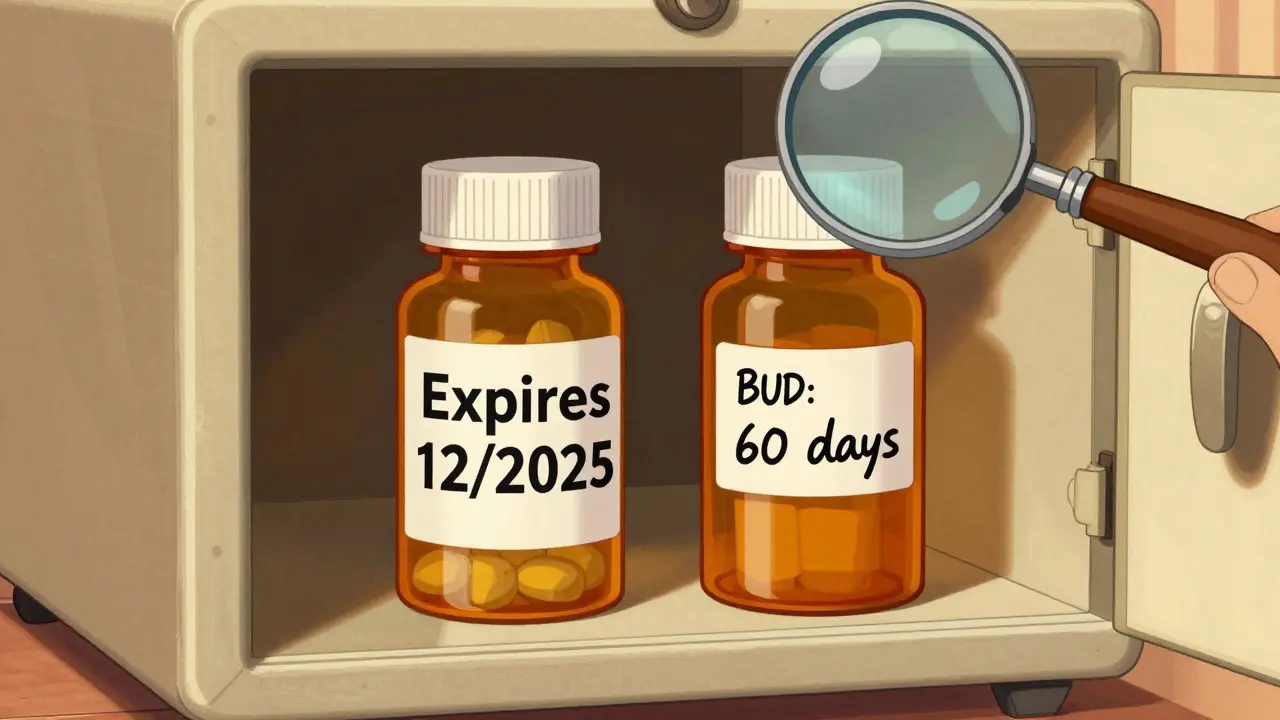
Have you ever looked at a pill bottle and seen two different dates? One says expiration date, the other says beyond-use date. You might think they mean the same thing - but they don’t. And mixing them up could mean taking a pill that doesn’t work - or worse, one that’s unsafe.
Let’s cut through the confusion. If you’re on a compounded medication - maybe a liquid version of a pill you can’t swallow, or a cream without dyes or preservatives - you need to understand the difference between these two dates. It’s not just pharmacy jargon. It’s about whether your medicine will do what it’s supposed to.
What Is a Manufacturer Expiration Date?
An expiration date is printed on every FDA-approved medication you buy at a pharmacy: antibiotics, blood pressure pills, insulin, even ibuprofen. This date isn’t arbitrary. It’s the result of years of testing.
Manufacturers don’t just guess how long a drug lasts. They test it under controlled conditions - high heat, high humidity, light exposure - to see how it breaks down over time. The FDA requires this. The goal? To guarantee that the medication still contains at least 90% of its labeled strength until that date. That’s not a soft target. It’s a legal requirement.
For example, if a bottle of amoxicillin says "Expires 12/2025," the manufacturer is legally responsible for ensuring it’s still safe and effective through that date. Even if you opened the bottle last year. Even if you stored it in a hot bathroom. The date doesn’t change.
But here’s the catch: this guarantee only applies if the medication stays in its original, unaltered packaging. Once you open it. Once you mix it. Once a pharmacist repackages it - that expiration date no longer applies.
What Is a Beyond-Use Date?
A beyond-use date (BUD) is what you see on compounded medications. These are drugs made by a pharmacy to meet a specific patient need. Maybe you’re allergic to the dye in a commercial pill. Maybe you’re a child who can’t swallow tablets. Maybe you need a custom dose that no company makes.
When a pharmacist makes that custom mix, they’re creating something new. And because it’s not mass-produced, it hasn’t gone through the same stability testing as commercial drugs. So, they can’t use the manufacturer’s expiration date. Instead, they assign a BUD.
This date is based on USP (United States Pharmacopeia) guidelines - not guesswork. For example:
- A simple oral liquid made from two commercial powders might get a BUD of 34 days at room temperature.
- A cream mixed with water? That one might only last 14 days - even if refrigerated.
- A sterile IV bag? Could be good for up to 7 days if stored properly.
The BUD is always calculated from the day the pharmacy made it - not from the original manufacturer’s date. And it’s always shorter. Why? Because compounded medications lack the stabilizers and preservatives that commercial drugs have. They’re more likely to grow bacteria, lose strength, or separate.
Key Differences Between the Two Dates
It’s not just about timing. The whole system behind each date is different. Here’s how they stack up:
| Feature | Manufacturer Expiration Date | Pharmacy Beyond-Use Date (BUD) |
|---|---|---|
| Applies to | Unaltered, FDA-approved commercial drugs | Compounded or repackaged medications |
| Determined by | Manufacturer using FDA-required stability testing | Pharmacist using USP Chapter <795> guidelines |
| Typical duration | 12-60 months from manufacturing | 14 days to 1 year (usually under 6 months) |
| Storage conditions | Based on manufacturer’s testing (e.g., room temp) | Often stricter - may require refrigeration even if original didn’t |
| Legal basis | Federal law (FDA 21 CFR 211.137) | State pharmacy law, guided by USP standards |
| Can it be extended? | No - even if stored perfectly | No - pharmacist sets it based on risk |
The biggest surprise for most patients? A compounded medication might have a BUD that’s shorter than the original expiration date. For example, you might get a prescription for a 6-month supply of thyroid medication. The original bottle says it expires in 2027. But the pharmacist repackages it into a smaller container - and writes a BUD of 6 months from today. That’s legal. And it’s based on real science.
Why BUDs Are Shorter - And Why That Matters
Let’s say you’re given a compounded pain cream. The pharmacist says it’s good for 90 days. You don’t use it all. You stash it in the medicine cabinet. Six months later, you dig it out. It looks fine. No weird smell. No discoloration.
But here’s the problem: you can’t see degradation. You can’t tell if the active ingredient has broken down to 70% potency - or if bacteria have grown in the base. That’s why BUDs are conservative. They’re not about what looks bad. They’re about what could harm you.
Compounded medications don’t have preservatives. They’re often water-based. Water invites mold. Heat and light speed up chemical breakdown. A pill made in a factory has protective coatings and controlled environments. A cream made in a pharmacy doesn’t.
One 2022 survey found that 68% of patients on compounded medications threw them away before finishing the course - mostly because the BUD expired. That’s not laziness. It’s fear. And it’s justified.
What Happens If You Use Something Past Either Date?
Using a drug past its expiration date doesn’t automatically make you sick. Some studies - like one from the FDA - found that 90% of drugs tested 15 years past their expiration were still potent under ideal lab conditions.
But here’s the thing: your home isn’t a lab.
That bottle in your bathroom? Exposed to steam and heat. That pill in your purse? Left in a hot car. That liquid medication sitting on your counter? Could be growing bacteria.
For commercial drugs, the risk is usually low potency. You might not feel the effect. For compounded meds? The risk is higher. Contamination. Toxic breakdown products. Allergic reactions from degraded ingredients.
The FDA doesn’t recommend using expired drugs. And pharmacists won’t tell you to. Why? Because they’ve seen patients get sick - not from the illness they’re treating, but from the medicine they thought was still good.
What Should You Do?
Here’s your simple checklist:
- Check both dates. If it’s a regular pill from a big pharmacy, trust the expiration date. If it’s a custom liquid, cream, or capsule from a compounding pharmacy, trust the BUD.
- Store it right. If the BUD says "refrigerate," don’t leave it on the counter. Even if the original drug didn’t need it.
- Don’t guess. If the date has passed, don’t take it. Even if it looks fine.
- Return it. Most pharmacies offer free take-back programs. Ask. They’ll take expired or unused meds - even compounded ones - and dispose of them safely.
- Ask questions. If you’re confused, call the pharmacy. Say: "Can you explain the BUD on this?" They’re trained to explain it.
There’s no shame in throwing away a $120 compounded medication. The cost of a wrong dose - or an infection - is far higher.
What’s Changing in 2026?
USP is updating its guidelines for BUDs in 2026. The goal? To make them even safer. Some high-risk compounded products may see their maximum BUD cut by 30%. That means more waste - but also fewer risks.
Meanwhile, the compounding market is growing fast. More people need custom meds. More pharmacies are offering them. But inconsistent rules across states mean some patients get longer BUDs than others. That’s changing. Standardization is coming.
For now, the rule is simple: expiration date = manufacturer’s promise. Beyond-use date = pharmacist’s safety limit. Don’t confuse them. Don’t ignore them. Your health depends on it.


Write a comment