
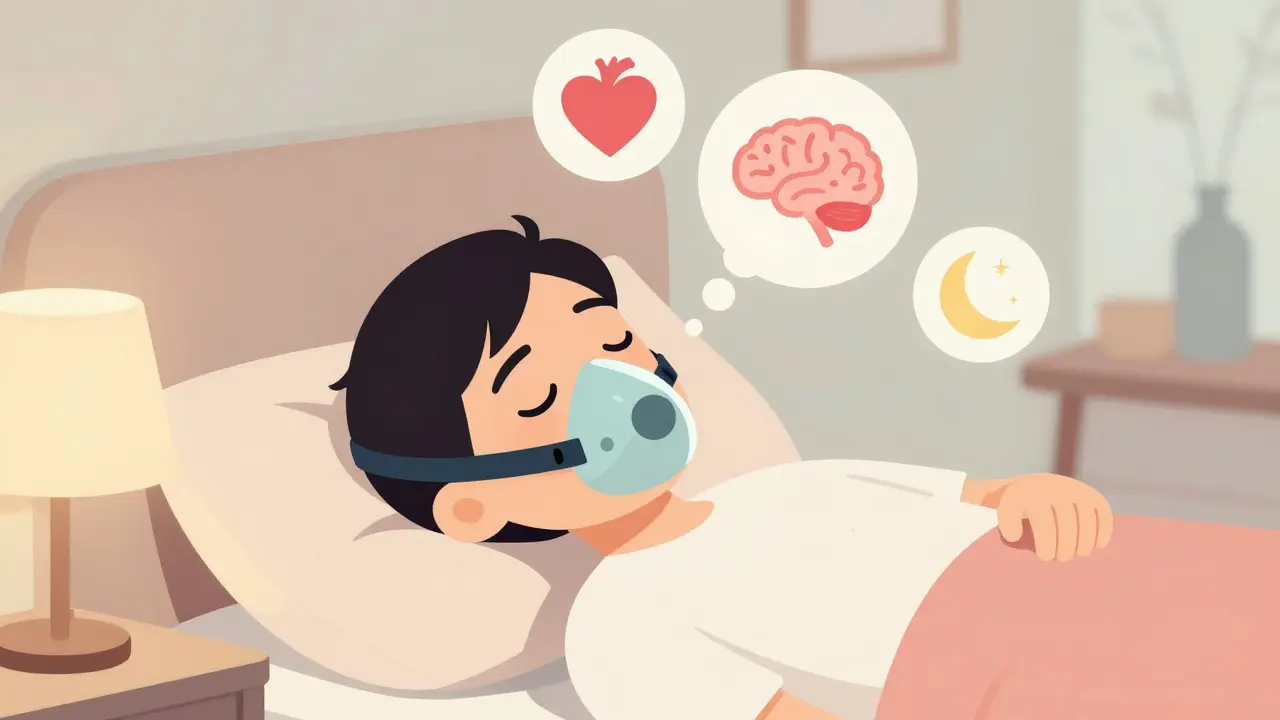
Getting a good night’s sleep shouldn’t feel like a battle. But if you have obstructive sleep apnea, every night can feel like a fight for air. That’s where CPAP machines come in. They’re not glamorous, but for millions of people, they’re the difference between exhaustion and energy, between high blood pressure and stability, between snoring and silence. The truth? CPAP machines work-when they’re used. And that’s where most people struggle.
What CPAP Machines Actually Do
CPAP stands for Continuous Positive Airway Pressure. It’s a simple idea: a small machine pushes a steady stream of air through a mask to keep your airway open while you sleep. No collapse. No pauses. No gasping for breath. It’s not a cure, but it’s the most effective non-surgical treatment for moderate to severe obstructive sleep apnea. Studies show consistent users cut their risk of heart attacks and strokes by 20-30%. That’s not a small win.
The first working CPAP device was built in 1980 by Dr. Colin Sullivan in Australia. Today, over 22 million Americans have sleep apnea-and 80% of them don’t even know it. That’s the real problem. The machines are here. The science is solid. But getting people to use them? That’s the hurdle.
The Four Main Types of CPAP Machines
Not all CPAP machines are the same. Choosing the wrong one can make adherence harder-or even impossible. Here’s what’s actually out there.
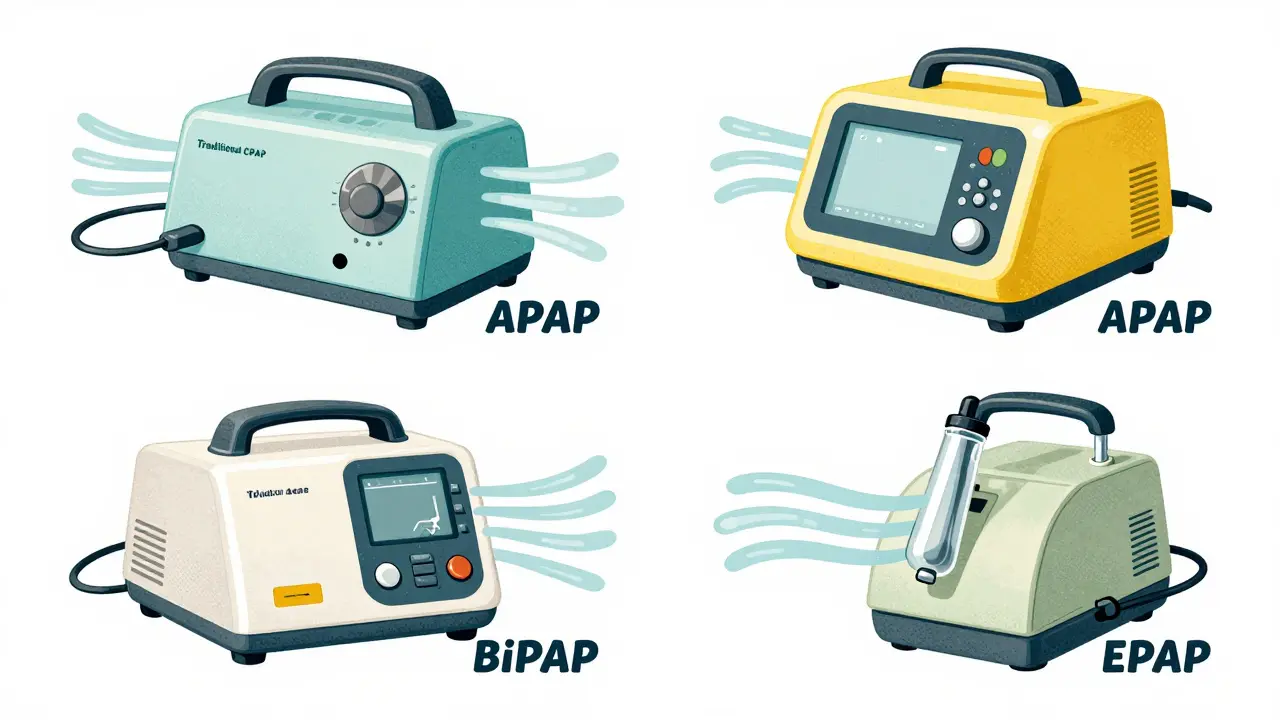
- Traditional CPAP: Delivers one fixed pressure all night. Most common, least expensive. Prices range from $500 to $1,000. Popular models like the ResMed AirSense 10 and Philips DreamStation fall here. Good if your pressure needs are stable. Not ideal if you toss and turn, gain weight, or get sick-your pressure might not match your breathing.
- APAP (Auto-Adjusting CPAP): This machine watches your breathing and changes pressure on the fly. If you snore, it bumps up. If you’re calm, it drops down. It’s smarter. And it costs more-$1,700 to $3,000. But studies show 15% higher adherence because users aren’t fighting the machine. Dr. Raj Dasgupta at USC says APAP is becoming the new first choice for many new patients.
- BiPAP (Bilevel): Uses two pressures: higher when you inhale, lower when you exhale. Great if you need high pressure (above 15 cm H2O) or have other lung conditions like COPD. Costs $600-$1,600. But it requires extra testing to set correctly, adding $300-$500 to the cost. Only needed for 10-15% of users, but life-changing for them.
- EPAP (Expiratory Positive Airway Pressure): These are small, nasal devices you stick in your nostrils. They create resistance only when you breathe out. Cheap-$50 to $150 a month. But they only work for mild sleep apnea. One study found they’re only 45% effective for moderate to severe cases, compared to 85% for CPAP. Don’t waste money here if your AHI is over 15.
Market share? ResMed leads with 45%, Philips Respironics has 30%, and Fisher & Paykel holds 15%. ResMed’s AirSense 11 AutoSet has a 4.7/5 rating from over 1,200 reviews. Philips DreamStation sits at 4.5/5. The difference isn’t just brand-it’s how well the machine adapts to you.
Mask Fitting: The #1 Reason People Quit
Here’s the hard truth: 20-30% of people stop using CPAP not because the machine is noisy or bulky-but because the mask hurts. Or leaks. Or feels like a prison.
There are four main mask types:
- Nasal pillows: Tiny silicone tips that sit just inside your nostrils. Best for side sleepers. Least facial contact. Only 32% of users pick them, but they’re the top choice among long-term users. One Reddit user switched from a full nasal mask to the AirFit P10 and cut his leak rate from 15 L/min to 3 L/min.
- Nasal masks: Cover your nose. Most popular-45% of users. Good balance of comfort and seal. But if you’re a mouth breather, you’ll wake up with a dry throat.
- Full-face masks: Cover nose and mouth. Used by 18% of people, mostly those who breathe through their mouth. But they’re bulkier, harder to seal, and cause 35% more skin irritation than nasal pillows.
- Hybrid/oral masks: Rare. Only 5% use them. Designed for people with severe nasal blockages.
Proper fit isn’t guesswork. You need to measure your nasal bridge width, cheekbone shape, and facial contours. A bad fit causes 60% of leaks. ResMed says acceptable leak rates are under 24 L/min. Anything higher? You’re losing pressure. You’re not getting treatment.
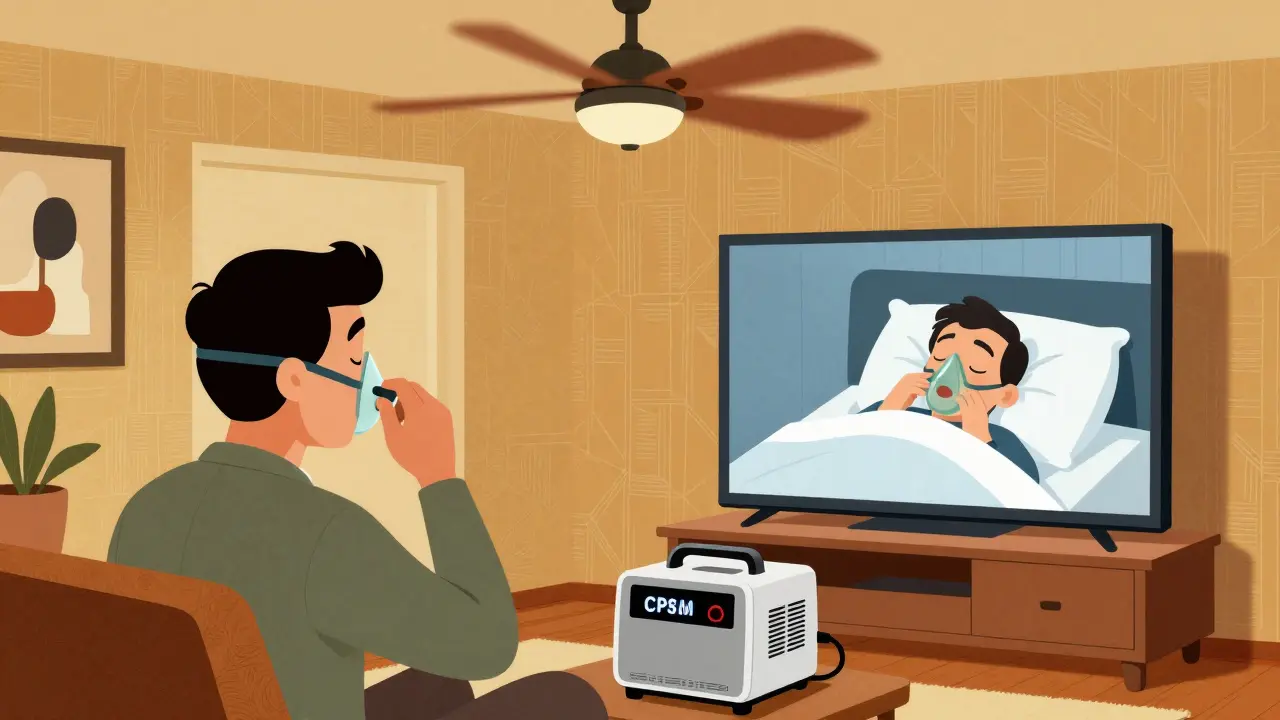
Try this: Wear the mask while watching TV for 10 minutes during the day. Breathe normally. Adjust the straps. Don’t tighten like a helmet. Tightening too much causes pressure sores. The goal is a seal, not a squeeze.
Why People Stop Using CPAP (And How to Keep Going)
GoodRx found that 42% of users quit within three months. Why? Mask discomfort. Dry nose. Noise. Feeling claustrophobic. The machine feels like a chore.
But here’s what works:
- Use the ramp feature. It starts with low pressure and slowly builds over 5-45 minutes. 75% of users use it. If you’re struggling to fall asleep, this is your friend.
- Get a heated humidifier. Dry air is the #1 complaint. Heated humidification reduces dryness complaints by 50%. Most machines include it now. If yours doesn’t, get one. It’s worth the extra $100.
- Use heated tubing. Cold air in the tube causes condensation-and that water can splash in your face. Heated tubing prevents that. Users with it have 78% adherence. Without? Just 52%.
- Start slow. Don’t try to wear it all night on day one. Do 2 hours during the day while reading or watching TV. Build tolerance. One user on CPAP.com said this cut his anxiety in half.
- Track your data. Modern machines show your AHI, leak rate, and usage hours. If you’re using it 4+ hours a night, 70% of nights, you’re doing well. ResMed’s myAir app gives personalized coaching-and users who use it have 27% higher adherence.
And don’t ignore accessories. CPAP pillows with cutouts for the mask? They reduce leaks by 40%. A 60-night trial from CPAP.com lets you swap masks without penalty. Use it.
What’s New in 2026
Technology didn’t stop. In 2023, ResMed launched the AirSense 11 with AI that predicts apnea events before they happen-and cuts AHI by 22%. Philips’ DreamStation 3 runs at 25 dBA-quieter than a whisper. Fisher & Paykel’s SleepStyle uses an algorithm that drops pressure by up to 50% during exhalation. That’s huge for people who hate the feeling of forced air.
Travel CPAPs like the ResMed AirMini ($650) are now common. It’s the size of a smartphone. But it doesn’t have a built-in humidifier-you need to buy one separately for $80. Noise levels are higher (52 dBA), so it’s not ideal for couples who sleep lightly.
Insurance rules changed too. Starting in 2024, Medicare and private insurers require proof you’re using your machine 4+ hours a night, 70% of nights-or they stop paying. Remote titration is now standard. You don’t need to drive to a sleep clinic. Your machine sends data to your doctor. They adjust your pressure from their computer.
When CPAP Isn’t Enough
Some people still struggle-even with the best mask and machine. That’s not failure. It’s a signal.
If you’re still waking up tired, your AHI might be too high. Or you might have central sleep apnea-where your brain doesn’t tell your body to breathe. That’s different. ResMed’s AirCurve 10 ASV machine treats that, but it costs $2,800 and needs a specialist to prescribe it.
Or maybe your problem isn’t the machine. It’s your weight. Your alcohol use. Your sleeping position. CPAP helps, but lifestyle changes make it better. Lose 10% of your body weight? Apnea improves by 50% in many cases.
And if you’ve tried everything? There are oral appliances, nerve stimulators, even surgery. But none match CPAP’s success rate. It’s still the gold standard.
Final Thought: It’s Not About the Machine. It’s About You.
CPAP machines don’t fix sleep apnea. You do. The machine is just the tool. The mask is the interface. The data is the feedback. But the commitment? That’s yours.
You don’t need the most expensive model. You don’t need the quietest. You need the one you’ll wear. The one that doesn’t make you feel like a robot. The one that lets you wake up feeling human again.
Try the ramp. Use the humidifier. Find your mask. Track your nights. Talk to your sleep specialist. Don’t give up after a week. It takes 2-4 weeks to adjust. For some, it takes three mask fittings.
One night of good sleep is worth it. A year of them? That’s life changed.
Can I buy a CPAP machine without a prescription?
No. In the United States, all CPAP machines require a prescription. Insurance also requires a sleep study and doctor’s note to cover costs. Even if you find a machine online without a prescription, it won’t be properly set for your needs-and you risk ineffective treatment or health complications.
Is APAP better than CPAP?
For most people, yes-especially if your breathing pattern changes during sleep, you’re overweight, or you have occasional nasal congestion. APAP adjusts pressure automatically, which leads to higher comfort and 15% better adherence than fixed-pressure CPAP. However, if your pressure needs are stable and you’re on a tight budget, a standard CPAP still works well.
Why does my CPAP mask leak?
Leaks usually happen because the mask doesn’t fit your face shape. Common causes: straps too loose or too tight, wrong mask type (e.g., nasal mask if you breathe through your mouth), or facial hair interfering with the seal. Try switching mask styles-many users find nasal pillows reduce leaks dramatically. Also, check for cracks or wear in the cushion. Replace it every 1-3 months.
How do I know if my CPAP is working?
Check your machine’s data: your AHI (Apnea-Hypopnea Index) should be under 5 events per hour. You should be using it 4+ hours per night, at least 70% of nights. You’ll also notice improvements: less daytime fatigue, better focus, fewer morning headaches, and quieter sleep for your partner. If you’re still tired, talk to your sleep specialist-your pressure might need adjusting.
Can I travel with my CPAP machine?
Yes. Most modern CPAP machines are FAA-approved for air travel. Use a travel CPAP like the ResMed AirMini if you want something lightweight. Always bring your power adapter and a backup battery if flying internationally. You don’t need to declare it as medical equipment at security, but keep your prescription handy in case you’re asked. Many airlines let you plug it in near your seat.
Will insurance cover my CPAP machine?
Most insurance plans cover 80% of the cost after you meet your deductible, but only if you have a confirmed diagnosis from a sleep study. You’ll usually need prior authorization. Medicare and Medicaid require proof of usage (4+ hours/night, 70% of nights) to continue coverage. If you stop using it, they may stop paying. Always check with your provider before buying.
What should I do if I hate my CPAP mask?
Don’t quit. Try a different mask type. Many suppliers offer 60-night trial periods. If nasal masks irritate your nose, switch to nasal pillows. If you breathe through your mouth, try a full-face mask with a chin strap. Adjust the headgear-tightening doesn’t help. Use a CPAP pillow with cutouts. And give yourself time. It takes weeks to adjust. Talk to your sleep clinic-they can help you find a better fit.
Next steps: If you’re struggling, schedule a follow-up with your sleep specialist. Bring your machine’s usage data. Ask about mask alternatives. Try a heated humidifier if you haven’t. And remember-every night you use it, you’re protecting your heart, your brain, and your future.


Write a comment