
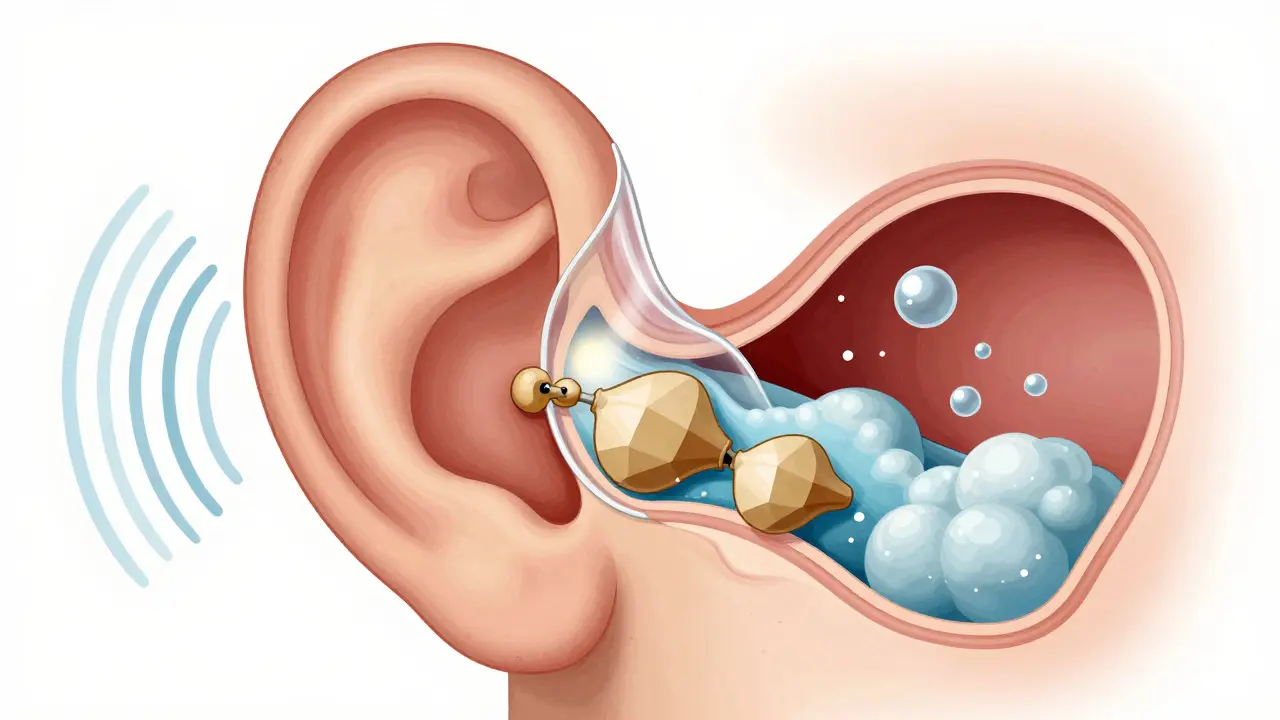
When sound doesn’t reach your inner ear properly, you don’t just hear less-you hear distorted. That’s the reality of conductive hearing loss. It’s not about damaged nerves or worn-out hair cells in the cochlea. It’s about a blockage or breakdown in the middle ear, the space behind the eardrum where three tiny bones work together to carry sound vibrations. This isn’t rare. It affects kids and adults, often silently, until you realize you’re turning up the TV again or asking people to repeat themselves. And unlike sudden sensorineural hearing loss, which needs emergency care, conductive hearing loss usually builds up slowly. But that doesn’t mean you can ignore it.
What Exactly Happens in the Middle Ear?
The middle ear is a small, air-filled chamber separated from the outer ear by the eardrum (tympanic membrane). Inside, three tiny bones-the malleus, incus, and stapes-link together like a chain. When sound hits the eardrum, it vibrates. Those vibrations move through the bones, pushing against the oval window of the cochlea. That’s how sound gets converted into nerve signals your brain understands. If any part of this system fails, sound gets muffled. It’s not gone. It’s just stuck. Common causes include earwax buildup, fluid trapped behind the eardrum, a perforated eardrum, or stiffening of the stapes bone. In children, fluid buildup-called otitis media with effusion or "glue ear"-is the most frequent cause of acquired hearing loss. In adults, otosclerosis is a leading culprit. That’s when abnormal bone growth fuses the stapes to the inner ear wall, preventing it from vibrating. Cholesteatomas, which are skin cysts growing in the middle ear, can erode bone and disrupt the ossicles. Congenital issues like aural atresia, where the ear canal never fully forms, also fall under this category.How Is It Diagnosed? (It’s Not Just a Quick Check)
A basic hearing test at a pharmacy won’t cut it. Conductive hearing loss requires a detailed audiological evaluation. The key is spotting an air-bone gap. This means sound travels poorly through the air (via the ear canal) but just fine when transmitted through bone (via a vibrator placed behind the ear). A gap of 15 to 60 decibels is typical, depending on how severe the blockage is. Doctors start with an otoscope-a lighted tool-to look for wax, fluid, or perforations. Then comes tympanometry. This test measures how well the eardrum moves under pressure. A flat reading (Type B tympanogram) almost always means fluid is trapped behind the eardrum. For more complex cases, a high-resolution CT scan of the temporal bone is needed. It shows bone structure, cholesteatoma growth, or ossicular damage. Audiologists need at least 3,000 clinical hours to reliably distinguish conductive from sensorineural loss. That’s why seeing a specialist matters.When Does It Need Surgery?
Not every case needs an operation. About 65% of pediatric cases resolve with antibiotics, ear tubes, or just time. But surgery becomes necessary when hearing loss stays above 25-30 dB for 3-4 months, or when structural damage is confirmed. Cholesteatomas are an exception-they’re always treated surgically because they destroy bone and can lead to brain infections if left alone. For children with chronic fluid buildup, tympanostomy tubes are the go-to solution. Around 667,000 of these procedures happen in the U.S. every year. A tiny tube is inserted into the eardrum to drain fluid and let air in. Most kids stop getting ear infections within weeks. About 75% of cases improve within three months. Parents report high satisfaction, though 18% deal with lingering drainage that needs extra treatment.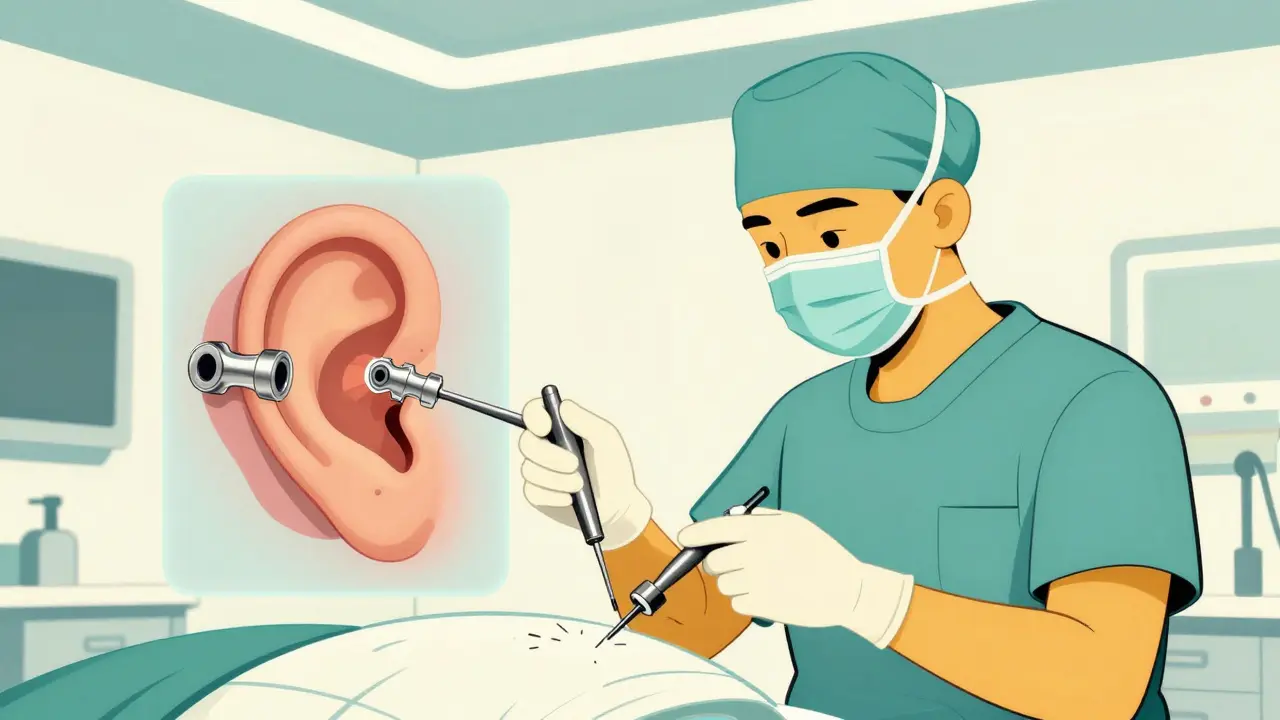
Surgical Options: What’s Actually Done
Different problems need different fixes.- Tympanoplasty: Used for eardrum perforations. Surgeons take a graft-often from the patient’s own tissue, like the temporalis fascia-and patch the hole. Success rates? 85-95% for small tears, 70-85% for larger ones. New bioengineered grafts made from extracellular matrix are now showing a 92% take rate, slightly better than traditional methods.
- Stapedectomy or Stapedotomy: For otosclerosis. The fixed stapes bone is either partially removed (stapedotomy) or replaced with a tiny prosthesis. Modern laser techniques have cut complication rates from 15% down to under 2%. In 80-90% of cases, the air-bone gap closes to within 10 dB. Patients often say they can hear whispers again.
- Canalplasty: For aural atresia. Surgeons reconstruct the ear canal using bone and skin grafts. Functional hearing improves in 60-70% of cases, but multiple surgeries are often needed, especially in young children.
- Cholesteatoma Removal: This is the most complex. The goal isn’t just to restore hearing-it’s to remove the cyst and make the ear safe and dry. Reconstruction of the ossicular chain may happen at the same time, or later. Recovery takes 4-6 weeks. Some patients report changes in sound quality afterward.
What to Expect After Surgery
Recovery isn’t quick. After tympanoplasty or stapedectomy, you’ll need to avoid water for six weeks. No swimming, no showers without ear protection. Pressure changes-like flying or scuba diving-are off-limits for at least eight weeks. Heavy lifting? Skip it for a month. Most people return to normal activities in 2-4 weeks, but full healing takes months. Side effects happen. About 7% of stapedectomy patients get temporary vertigo. Taste changes (a metallic or sour taste) occur in 4%-usually because the nerve running through the middle ear gets bumped. Tinnitus can flare up temporarily in 3%. These usually fade. But 27% of cholesteatoma patients report lasting changes in how sounds feel-like music or voices sounding "thin" or "off." That’s because the ear’s natural resonance has been altered.What’s New in Middle Ear Surgery?
The field is advancing fast. Intraoperative navigation systems, like GPS for the ear, are now used in 78% of ENT practices. They help surgeons avoid critical nerves and structures during delicate procedures. 3D-printed ossicular prostheses are being tested. Instead of a one-size-fits-all implant, surgeons now create custom titanium or biocompatible parts based on the patient’s CT scan. Early trials show 94% hearing improvement-better than the 85% from standard prostheses. Endoscopic surgery is another shift. Instead of making a large incision behind the ear, surgeons use a tiny camera inserted through the ear canal. It gives a clearer view and reduces recovery time by half. By 2028, experts predict this will be standard for 60% of procedures.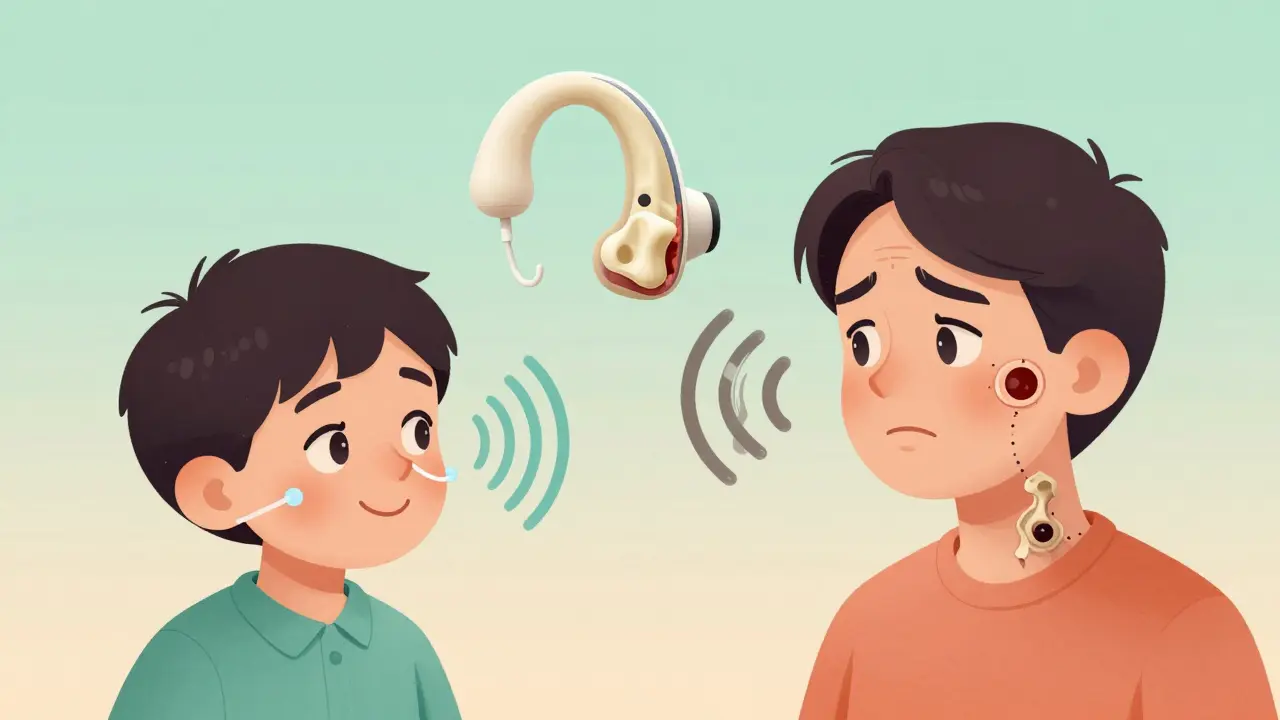
Real Results: What Patients Say
On patient portals, the feedback is clear. Of 1,245 people who had stapedectomy at Mass Eye and Ear, 87% reported "significant improvement in daily hearing." One wrote: "I finally heard my granddaughter say ‘I love you’ without asking her to repeat it." Another: "I stopped using subtitles on Netflix." But it’s not perfect. Some patients feel the trade-offs. One Reddit user said, "I can hear better, but now my own voice sounds weird. Like I’m talking in a tin can." Another: "I had tubes as a kid. They helped, but I still get infections sometimes." The takeaway? Surgery can change lives-but it’s not magic. Success depends on the cause, the surgeon’s skill, and how well you follow post-op rules.Costs and Access
In the U.S., a pre-op CT scan can cost $800-$1,200 out-of-pocket. The surgery itself ranges from $10,000 to $25,000 without insurance. Tympanostomy tubes are cheaper-often covered by insurance-but still require an anesthesiologist and hospital time. Globally, the middle ear surgery device market is growing fast, projected to hit $1.8 billion by 2027. That means more innovation, but also more pressure on healthcare systems to keep up.Final Thoughts
Conductive hearing loss isn’t just "a little hearing trouble." It’s a mechanical failure in a complex system. And when it doesn’t resolve on its own, surgery can be life-changing. But only if it’s the right surgery for the right problem. That’s why diagnosis matters more than ever. Don’t assume a hearing test at the mall is enough. See an audiologist. Get the full workup. If surgery is recommended, ask about the technique, the surgeon’s success rate, and what recovery really looks like. You’re not just fixing a bone-you’re restoring connection.Can conductive hearing loss go away on its own?
Yes, in many cases-especially in children. Fluid behind the eardrum (otitis media with effusion) often clears up within weeks or months without treatment. About 65% of pediatric cases resolve with medical management alone, like antibiotics or watchful waiting. In adults, earwax buildup or temporary fluid from a cold can also improve without intervention. But if hearing loss lasts more than 3-4 months or worsens, medical evaluation is needed.
Is surgery always necessary for conductive hearing loss?
No. Surgery is only considered when hearing loss is persistent (over 25-30 dB for 3-4 months) and medical treatments have failed. Many cases, especially in kids, improve with ear tubes or medication. Cholesteatomas are the main exception-they always require surgery because they destroy bone and can cause serious infections. For otosclerosis or eardrum perforations, surgery is highly effective but not mandatory; hearing aids are a valid alternative.
How successful is stapedectomy for otosclerosis?
Stapedectomy or stapedotomy is one of the most successful ear surgeries. In 80-90% of cases, the air-bone gap closes to within 10 decibels of normal hearing. Modern laser techniques have reduced complications like vertigo or taste changes from 15% down to under 2%. Most patients report dramatic improvements-like being able to hear whispers or no longer needing to turn up the TV. Long-term success rates remain high, with 85% still hearing well five years after surgery.
What’s the difference between tympanoplasty and myringotomy?
Tympanoplasty repairs a hole in the eardrum using a graft, often to restore hearing after trauma or infection. Myringotomy is a much simpler procedure: a tiny incision is made in the eardrum, and a tube is inserted to drain fluid. It’s commonly used in children with chronic ear infections or "glue ear." Tympanoplasty is for structural repair; myringotomy is for drainage and ventilation. Tubes usually fall out on their own after 6-12 months.
Can you hear normally after cholesteatoma surgery?
Hearing improvement is possible, but not guaranteed. The main goal of cholesteatoma surgery is to remove the cyst and prevent infection or damage to the brain. Restoring hearing is secondary. If the ossicles were destroyed, reconstruction may be attempted, but it often requires a second surgery. About 60-70% of patients see some hearing improvement, but many still need a hearing aid. Some report altered sound quality, like voices sounding "flat" or "distant."
Are there non-surgical alternatives to hearing loss from middle ear issues?
Yes. Hearing aids can be very effective for conductive loss, especially if surgery isn’t an option. Bone-conduction devices (like BAHA or bone-anchored hearing aids) bypass the middle ear entirely and send sound directly to the inner ear through the skull. For children with aural atresia, a softband bone-conduction device can be worn until they’re old enough for surgery. These options don’t fix the problem-but they restore hearing function without cutting into the ear.
How long does recovery take after middle ear surgery?
Recovery varies by procedure. For tympanostomy tubes, most kids feel better in a few days. For tympanoplasty or stapedectomy, expect 2-4 weeks before returning to work or school, but full healing takes 6-8 weeks. You must avoid water, pressure changes (flying, diving), and heavy lifting during that time. Cholesteatoma surgery often requires 4-6 weeks of recovery. Some patients feel normal sooner, but the ear needs time to heal internally-even if it feels fine on the outside.
Can conductive hearing loss become permanent?
Yes-if left untreated. A cholesteatoma can erode the bones of the inner ear, leading to permanent sensorineural loss. Chronic fluid buildup in children can delay speech development. Untreated otosclerosis will continue to worsen over time. Even a single, unhealed eardrum perforation can lead to scarring and stiffness, reducing sound transmission permanently. That’s why early diagnosis and timely treatment are critical.


Write a comment